

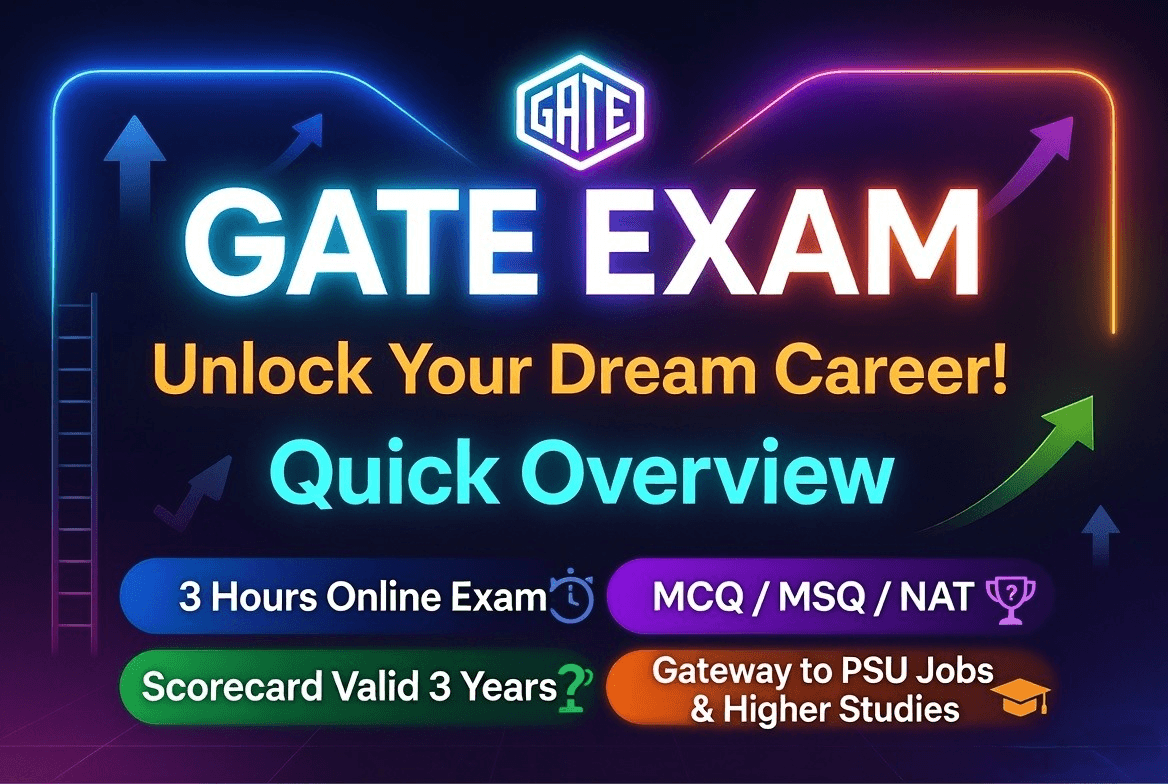
If you are a student or a working professional in the fields of engineering, technology, or science, you have likely heard of the GATE exam. It is widely regarded as one of the most prestigious and challenging competitive exams in India.
But what exactly is GATE, who is it for, and what kind of career doors can it open for you? Whether you are mapping out your final years of college or looking to pivot your professional trajectory, here is an ultimate, detailed guide to everything you need to know about the GATE exam.
What is the GATE Exam?
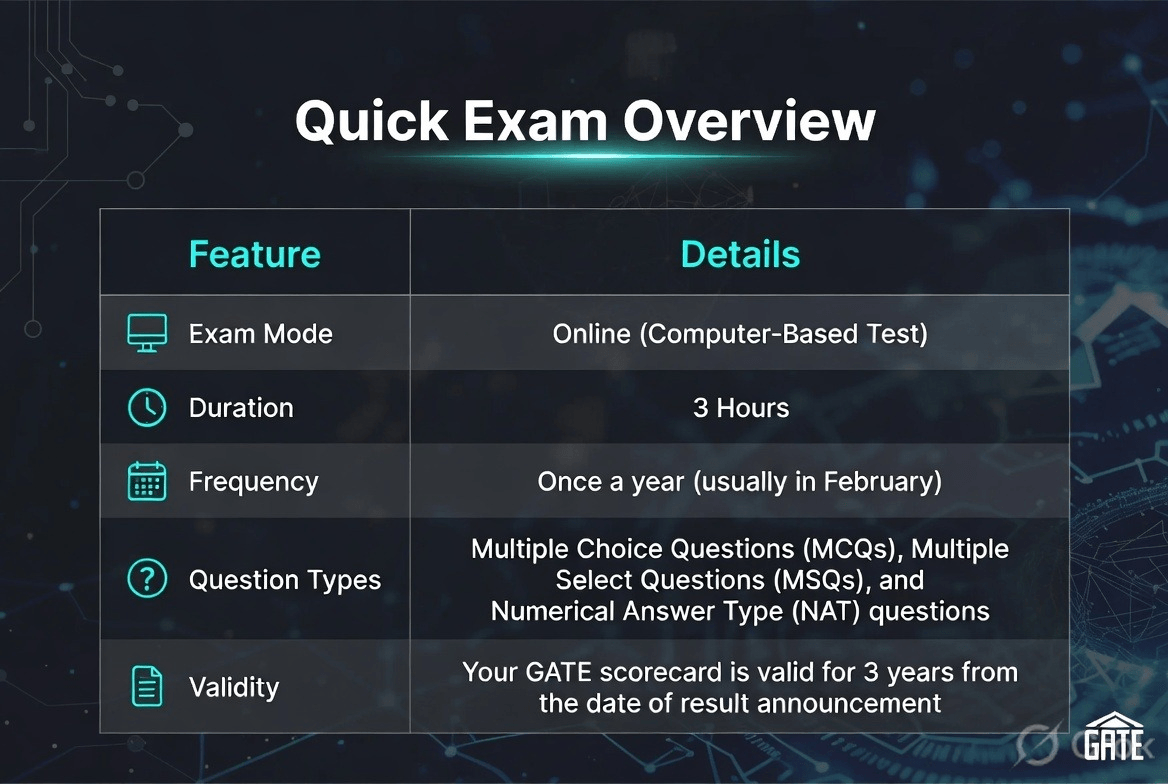
GATE stands for the Graduate Aptitude Test in Engineering. It is a national-level examination conducted jointly by the Indian Institute of Science (IISc), Bangalore, and seven Indian Institutes of Technology (IITs) on behalf of the National Coordination Board (NCB)-GATE and the Department of Higher Education.
The primary purpose of the exam is to test a candidate's comprehensive understanding of various undergraduate subjects in engineering, technology, architecture, and post-graduate level subjects in science.
GATE Eligibility Criteria
One of the best things about the GATE exam is its accessibility. The organizing authorities have made the eligibility rules highly inclusive to encourage continuous learning:
- Educational Qualification: Candidates currently in the 3rd year or higher of any undergraduate degree program (like B.E. / B.Tech / B.Arch / B.Sc. Research) are fully eligible to apply.
- Postgraduate Eligibility: Candidates who have completed or are in the final year of a Master’s degree in any branch of Science, Mathematics, Computer Applications, or Statistics can also sit for the exam.
- No Age Limit: There is absolutely no upper age restriction to appear for the GATE exam.
- No Minimum Percentage: There is no minimum percentage requirement in your graduation to sit for the exam; you just need to fulfill the degree criteria.
- Unlimited Attempts: You can attempt the GATE exam as many times as you like
Why Should You Write GATE? (The Massive Benefits)
Qualifying for the GATE exam isn't just about getting a certificate—it serves as a launchpad for three major career trajectories: Higher Education, Public Sector Jobs, and Advanced Global Research.
1. Direct Entry into Public Sector Undertakings (PSUs)
For many aspirants, this is the ultimate goal. Top-tier government-owned corporations (PSUs) use GATE scores directly to shortlist candidates for high-paying, secure engineering executive roles.
- Companies like IOCL, ONGC, NTPC, BHEL, BARC, HPCL, and PowerGrid bypass independent written tests and hire directly through your GATE rank, followed by an interview.
2. Post-Graduate Admissions (M.Tech / M.S. / Ph.D.)
A valid GATE score is your golden ticket into India’s premier institutes:
- The IITs and NITs: Secure admission into Master of Technology (M.Tech) or Master of Science (M.S.) programs at prestigious Indian Institutes of Technology (IITs) and National Institutes of Technology (NITs).
- Financial Stipend: Regular students admitted to MHRD-funded postgraduate programs receive a monthly stipend of ₹12,400, helping you "earn while you learn".
- Fellowships: If you choose a management fellow track at premium institutes like IIMs, the financial fellowship can scale even higher.
3. Prestigious Research & Development Roles
If your passion lies in cutting-edge technology and innovation, a solid GATE score opens doors to major national research labs:
- You can apply for prestigious Junior Research Fellowships (JRF) or technical positions in organizations like ISRO, DRDO, and CSIR Laboratories.
4. Global Opportunities
Did you know your GATE score can take you abroad? Top international universities, such as the National University of Singapore (NUS), Nanyang Technological University (NTU) in Singapore, and several renowned universities in Germany and New Zealand, accept GATE scores for their postgraduate engineering programs. 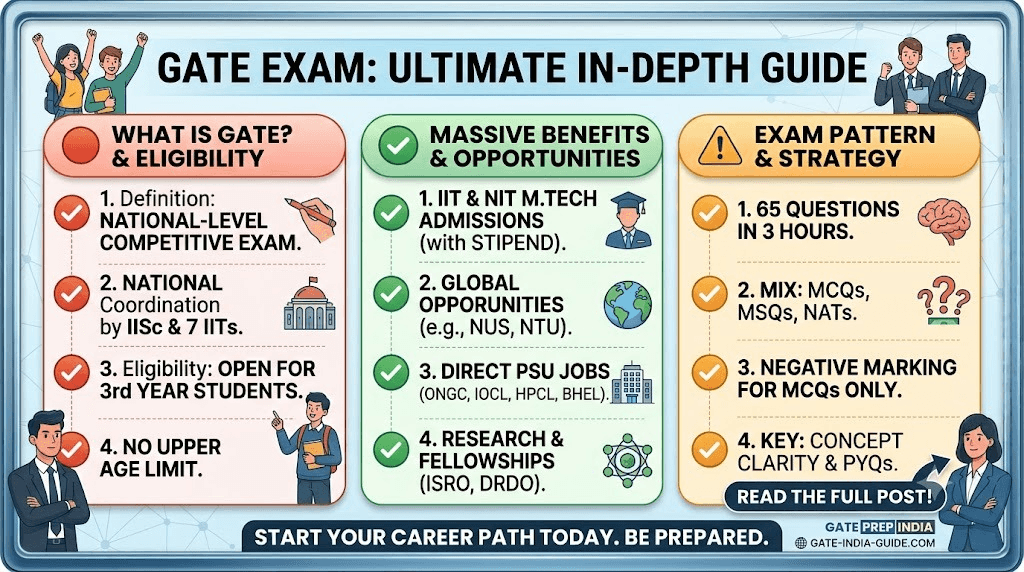
The General Paper Structure
The GATE exam consists of a single paper containing 65 questions worth a total of 100 marks. Regardless of the subject code you choose (e.g., Computer Science, Mechanical, Mathematics), the paper is generally split into two core components:
1. General Aptitude (15 Marks): Standard across all test papers, this evaluates verbal, analytical, spatial, and quantitative reasoning skills.
2. Core Subject & Engineering Mathematics (85 Marks): Focuses heavily on depth, technical expertise, and problem-solving abilities related to your specific discipline.
Note: There is negative marking for wrong answers in standard Multiple Choice Questions (MCQs), but no negative marks for Numerical Answer Type (NAT) or Multiple Select Questions (MSQs).
How to Kickstart Your Preparation
The vastness of the GATE syllabus means that concept clarity is much more important than rote memorization. If you're planning to prepare:
- Analyze the Syllabus: Download the exact PDF syllabus for your chosen paper code and stick to it.
- Strengthen Foundations: Pick a subject you love and master the fundamentals first. For analytical fields, establishing a firm grip on Discrete Mathematics and engineering math early on builds strong analytical foundations.
- Solve Previous Year Questions (PYQs): GATE is famous for not repeating questions but consistently repeating core underlying concepts. Solving at least 10–15 years of PYQs is mandatory.
- Take Mock Tests: Learn to manage your 3-hour window and get comfortable using the official on-screen virtual calculator.
Final Thoughts
The GATE exam demands discipline, consistency, and a true passion for your subject. It is tough, but the payoff—whether it's a dream job at a top PSU, a research opportunity at ISRO, or a Master's degree from an IIT—makes every hour of study worth it.
Identify your target, organize your study material, and start tackling it one topic at a time!