

Introduction
As artificial intelligence systems become more sophisticated, the information surrounding an AI request can be almost as important as the prompt itself. This is where metadata enters the picture.
For developers working with Claude, Anthropic's family of AI models, metadata can refer to additional information associated with AI requests, responses, skills, files, or evaluation workflows. Understanding the term is particularly important because "Claude metadata" is not a single feature with one universal meaning—it can describe different types of supporting information depending on the Claude product or development environment.
Anthropic's current documentation shows metadata being used in areas such as Claude Skills, while the Claude API also exposes structured request and response information and supports a wide range of parameters for controlling how applications interact with models.
For technology enthusiasts, developers, and AI researchers, understanding Claude metadata provides a useful window into how modern AI applications are organized, monitored, customized, and integrated into larger software systems.
What Is Claude Metadata?
In simple terms, metadata is information about information.
For Claude-related systems, metadata can describe an AI resource without necessarily being the main content that Claude processes.
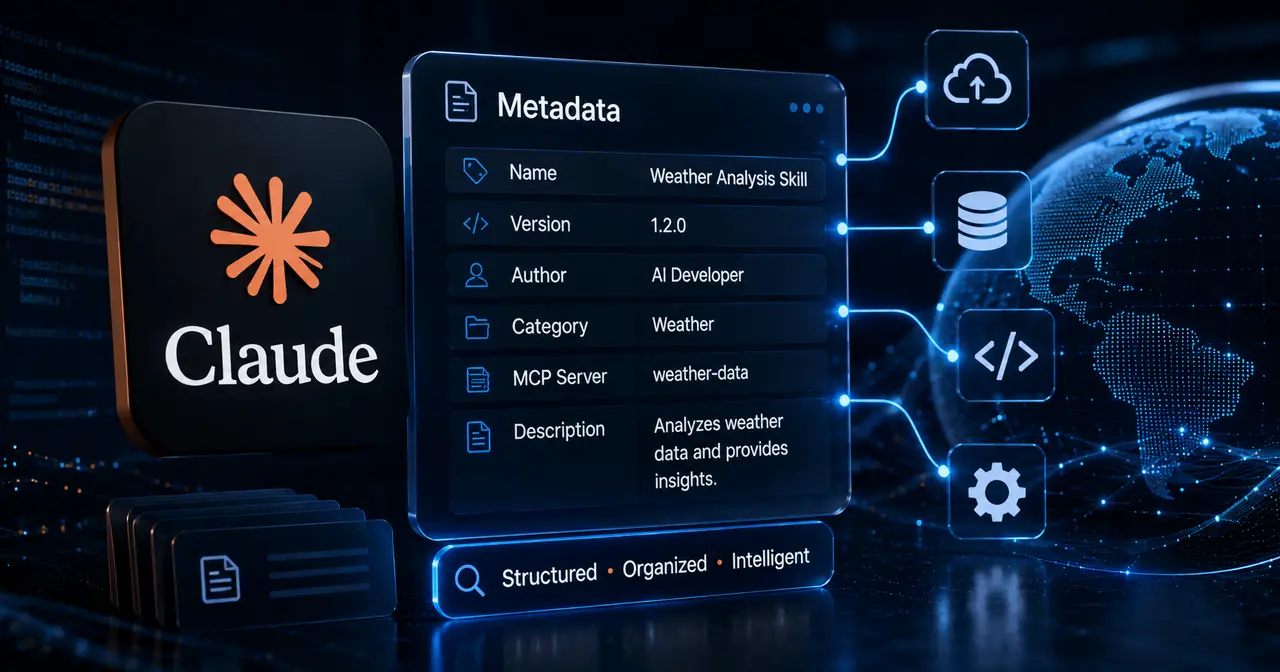
For example, metadata associated with a reusable AI skill might contain information such as:
- Author
- Version
- Category
- MCP server
- Documentation
- Other custom key-value information
Anthropic's guide to building Skills for Claude specifically describes metadata as optional custom information and recommends fields such as author, version, and mcp-server.
The important point is that metadata is generally supporting information, rather than the primary content itself.
Why Is Metadata Important in AI?
Modern AI applications rarely consist of a simple question followed by an answer.
A production AI application may involve:
- A user
- An application
- A model
- System instructions
- Tools
- Files
- External services
- Skills
- Security controls
- Logging and analytics
Metadata can help applications understand and organize these different components.
For example, an application may need to know:
Which version of a skill is being used?
or:
Which resource should be associated with this workflow?
Metadata can provide that additional context.
Claude Metadata in AI Skills
One of the clearest current examples is Claude Skills.
Anthropic's documentation explains that Skills use metadata and descriptions to provide Claude with enough information to determine when a particular skill should be used without loading the entire skill into context. This is part of a broader concept called progressive disclosure.
What Can Skill Metadata Contain?
A Skill's metadata can include custom fields such as:
metadata:
  author: Example Company
  version: 1.0.0
  mcp-server: example-server
  category: productivity
The exact fields depend on the Skill and its intended purpose.
This makes metadata useful for organizing reusable AI capabilities.
Metadata and Progressive Disclosure
Progressive disclosure is particularly interesting for AI systems.
Instead of giving Claude every piece of information about every available capability at once, a system can provide a smaller amount of descriptive information first.
Claude can then determine whether a particular capability is relevant before loading additional instructions or resources.
This approach can help reduce unnecessary context and make complex AI workflows easier to manage. Anthropic's Skills documentation describes metadata and descriptions as part of this progressive-disclosure architecture.
Claude API and Metadata
The Claude API provides programmatic access to Claude models through APIs such as the Messages API. Developers can send structured conversations containing user and assistant messages, along with other parameters that control model behavior.
The Messages API request structure includes information such as:
- Model
- Messages
- Maximum output tokens
- System instructions
- Tools
- Temperature and sampling parameters
- Streaming options
- Other supported configuration parameters
The resulting API response contains structured information such as a message ID, generated content, model-related information, and usage information.
This distinction is important: not every piece of structured information in a Claude API request or response should automatically be called "metadata." Developers should use the terminology appropriate to the specific API field or feature.
Metadata vs Prompt Content
A useful way to understand metadata is to compare it with the actual prompt.
Prompt Content
Prompt content is the information you want Claude to process.
For example:
"Explain how monsoon clouds form."
Metadata
Metadata could describe the resource or workflow associated with that request.
For example:
- Application: Weather Research Tool
- Version: 2.1
- Category: Meteorology
- Workflow: Educational Explanation
The metadata doesn't necessarily constitute the question itself. Instead, it helps the surrounding software understand and manage the request or resource.
Claude Metadata and AI Skills Management
As AI applications become more modular, developers increasingly need ways to organize reusable capabilities.
Imagine an AI system with hundreds of specialized Skills:
- Data analysis
- Weather forecasting
- Financial reporting
- Coding
- Document processing
- Graphic design
- Research
- Customer support
Without descriptive information, managing these capabilities becomes difficult.
Metadata can provide useful organizational information such as the Skill's:
- Purpose
- Version
- Creator
- Dependencies
- Category
- Integration requirements
This can make large AI workflows easier to maintain.
Metadata and MCP
The Model Context Protocol (MCP) is another important part of the modern AI ecosystem.
Anthropic describes connectors as a way for Claude to access external knowledge and tools, with MCP-powered integrations helping Claude interact with connected applications and data.
Metadata can be useful around these integrations because developers may need information about:
- Which MCP server provides a capability
- Which version is being used
- What category a tool belongs to
- What external dependency is required
Anthropic's Skills guide even gives mcp-server as an example of an optional metadata field.
Metadata in AI Development Workflows
For developers, metadata becomes increasingly valuable as AI applications move from experiments to production.
A mature AI workflow may need to track:
Versioning
Which version of a prompt, Skill, or resource was used?
Ownership
Who created or maintains the resource?
Dependencies
Does the resource depend on a particular external service?
Classification
What category does the capability belong to?
Documentation
Where can developers find additional information?
These details can make AI systems more manageable and auditable.
Claude Metadata and AI Security
Metadata can also have security implications.
Anthropic's Skills documentation places restrictions on certain frontmatter content, including XML angle brackets, because Skill metadata and descriptions can appear in Claude's system-level context. The documentation specifically warns that malicious content could potentially be used for instruction injection.
This highlights an important principle:
Metadata should not automatically be treated as harmless administrative information.
When metadata is surfaced to an AI model, its contents can influence how the model understands a resource or capability.
Developers should therefore validate metadata and follow the security guidance associated with the relevant Claude feature.
Can Metadata Affect Claude's Response?
It depends on where and how the metadata is used.
Metadata that exists only for an application's internal database may never reach the model.
However, metadata incorporated into a Skill's description or system context can influence which capability Claude chooses to use or how it interprets that capability.
Anthropic's documentation explains that Skill descriptions and metadata help Claude determine when a Skill should be used.
Therefore, developers should distinguish between:
Application-only metadata
Information used by software outside the model.
Model-visible metadata
Information that is supplied to Claude and can influence model behavior.
Claude Metadata and Privacy
Metadata can also raise privacy questions.
AI applications may generate or store information about users, requests, resources, organizations, or workflows.
However, developers should not assume that every piece of metadata has the same retention or privacy characteristics.
Anthropic publishes specific documentation describing data retention for its APIs and different capabilities. For example, its current API documentation distinguishes standard Messages API processing from features such as the Files API, MCP connectors, and code execution.
For production systems, developers should therefore review the applicable Anthropic privacy and data-retention documentation rather than treating "metadata" as one universal data category.
Claude Metadata vs AI Training Data
These concepts are often confused.
Metadata
Information describing a resource, workflow, request, or other data.
Training Data
Information used to train an AI model.
They are fundamentally different concepts.
For example, a Skill could contain metadata describing its author and version. That does not mean the metadata itself is training data.
Similarly, information associated with an API request should not automatically be interpreted as part of Claude's model training process.
Developers should consult the applicable Anthropic data-use documentation for specific products and configurations.
Practical Example of Claude Skill Metadata
Consider a fictional weather-analysis Skill:
name: weather-analysis
description: Analyzes weather datasets and creates clear summaries.

metadata:
  author: Weather Research Team
  version: 2.0
  category: meteorology
  mcp-server: weather-data
Here:
nameidentifies the Skill.descriptionexplains its purpose and potential use.authoridentifies the creator.versionhelps with maintenance.categoryhelps organize the Skill.mcp-serveridentifies a related integration.
The metadata itself doesn't perform the weather analysis. Instead, it provides useful information about the capability.
Why Claude Metadata Matters for SEO and Content Creators
Metadata is also relevant to bloggers and digital publishers working with AI.
AI-assisted content workflows may involve:
- Content categories
- Article versions
- Author information
- Research sources
- Publication dates
- SEO keywords
- Content status
- AI workflow versions
Although these are not necessarily Claude-specific metadata fields, the same principle applies: structured descriptive information can help software organize content and workflows.
For bloggers building automated AI content pipelines, metadata can become particularly valuable when managing hundreds or thousands of articles.
The Future of Claude Metadata
As AI systems become more capable and autonomous, metadata is likely to become increasingly important.
Future AI applications may rely on structured information to manage:
- AI Skills
- Agents
- Tools
- MCP integrations
- Data sources
- Permissions
- Workflow versions
- Enterprise policies
- Audit information
The more capabilities an AI system can access, the more important it becomes to understand what each capability does, when it should be used, and what dependencies it requires.
Anthropic's continuing development of Skills, MCP-based integrations, and increasingly capable Claude models illustrates this broader movement toward modular AI systems.
Frequently Asked Questions
What is Claude metadata?
Claude metadata refers broadly to structured information associated with Claude resources, Skills, workflows, or application integrations. Its exact meaning depends on the Claude feature being discussed.
What is metadata in Claude Skills?
In Claude Skills, metadata can contain optional custom key-value information such as author, version, category, or MCP-server details.
Is Claude metadata the same as prompt data?
No. Metadata generally describes or supports a resource or workflow, while prompt data is the actual information supplied for Claude to process.
Can Claude metadata influence AI behavior?
Model-visible metadata and Skill descriptions can help Claude determine when a capability should be used. Application-only metadata may never be shown to the model.
Is Claude metadata private?
Privacy and retention depend on the product, feature, and implementation. Developers should consult Anthropic's current data-retention and privacy documentation for the specific Claude service they are using.
Sources: Verified & Authoritative
- Anthropic – Complete Guide to Building Skills for Claude: Official documentation covering Skill structure, descriptions, metadata, progressive disclosure, and security considerations.
- Anthropic – Claude API Reference: Official documentation for the Messages API and its request/response structure.
- Anthropic – API Overview: Official overview of the Claude API and available APIs.
- Anthropic – Connect Your Tools: Official information about connectors and MCP-powered capabilities in Claude.
- Anthropic – API and Data Retention: Official information about retention characteristics across Claude API capabilities.
- Anthropic – Claude's Constitution: Official documentation explaining Anthropic's intended values and behavioral framework for Claude.