

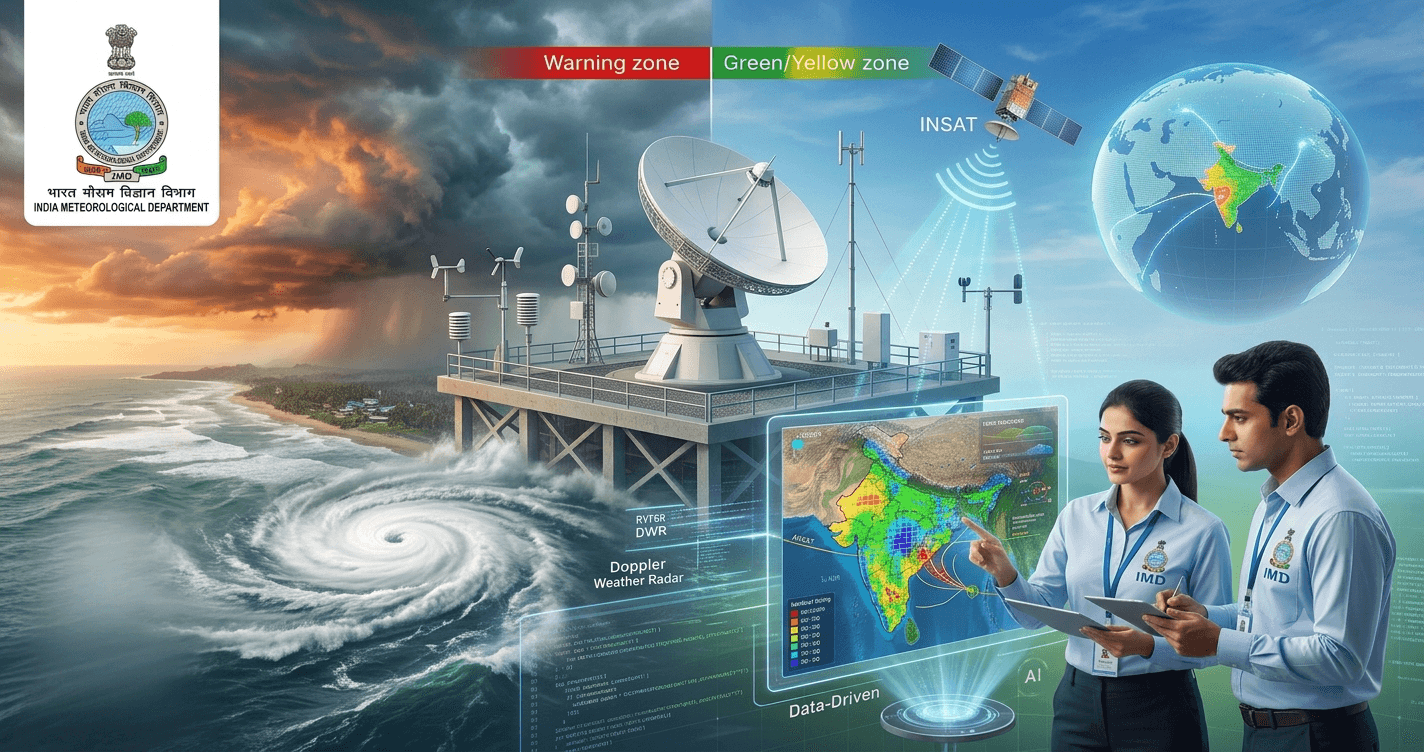
India Meteorological Department (IMD): India's Weather Forecasting Powerhouse Transforming Climate Intelligence
Introduction
Whether you're planning a weekend trip, tracking the monsoon, preparing for a cyclone, or simply checking tomorrow's weather, one organization works tirelessly behind the scenes to keep millions of Indians informed—the India Meteorological Department (IMD).
As India's official weather forecasting agency, the IMD plays a crucial role in predicting weather patterns, issuing early warnings, monitoring climate change, and protecting lives and property from natural disasters. In an era where climate change is making weather increasingly unpredictable, the importance of accurate forecasting has never been greater.
In this article, we'll explore everything you need to know about the India Meteorological Department, including its history, responsibilities, technologies, forecasting methods, achievements, challenges, and future innovations.
What is the India Meteorological Department (IMD)?
The India Meteorological Department (IMD) is the national meteorological service of India. It functions under the Ministry of Earth Sciences (MoES) and is responsible for observing, analyzing, and forecasting weather conditions across the country.
Established in 1875, the IMD has grown into one of the world's leading meteorological organizations, providing weather forecasts, cyclone warnings, earthquake monitoring, and climate-related information.
Today, the department serves millions of people every day through television, radio, newspapers, websites, mobile applications, and social media platforms.
History of the India Meteorological Department
The IMD was established in 1875 after several devastating cyclones and monsoon failures highlighted the need for a centralized weather monitoring system.
Some major milestones include:
- 1875 – IMD officially established.
- 1947 – Expanded nationwide weather observation after independence.
- 1970s – Introduction of satellite meteorology.
- 1990s – Computerized numerical weather prediction.
- 2000s – Doppler Weather Radar network expansion.
- Present Day – AI-assisted forecasting, satellite-based observations, and advanced climate monitoring.
Over nearly 150 years, IMD has evolved from manual observations to sophisticated digital forecasting systems.
Major Responsibilities of the India Meteorological Department
The IMD performs a wide range of critical functions.
1. Weather Forecasting
The department provides:
- Daily weather forecasts
- Weekly forecasts
- Monthly outlooks
- Seasonal forecasts
- Monsoon predictions
These forecasts help citizens, businesses, and governments make informed decisions.
2. Cyclone Monitoring
India experiences several tropical cyclones every year.
IMD continuously monitors:
- Arabian Sea cyclones
- Bay of Bengal cyclones
- Storm intensity
- Storm tracks
- Landfall predictions
Its early warnings have significantly reduced cyclone-related fatalities over the past decades.
3. Monsoon Forecasting
The Indian economy heavily depends on the southwest monsoon.
IMD predicts:
- Monsoon onset
- Rainfall distribution
- Rainfall deficiency
- Excess rainfall
- Withdrawal dates
These forecasts are particularly valuable for farmers and agricultural planners.
4. Disaster Warning Services
The IMD issues alerts for:
- Heavy rainfall
- Heatwaves
- Cold waves
- Thunderstorms
- Lightning
- Fog
- Dust storms
- Cyclones
These warnings help disaster management agencies prepare in advance.
5. Climate Monitoring
IMD also studies long-term climate trends such as:
- Rising temperatures
- Rainfall variability
- Climate change impacts
- Seasonal anomalies
- Drought assessment
Its climate reports support scientific research and policymaking.
Technologies Used by IMD
Modern weather forecasting relies heavily on advanced technology.
Doppler Weather Radar (DWR)
These radars monitor:
- Rainfall intensity
- Thunderstorms
- Wind movement
- Cyclones
- Cloud formations
Radar data enables short-term forecasts known as "nowcasting."
Weather Satellites
Satellite observations help IMD monitor:
- Cloud cover
- Cyclones
- Monsoon systems
- Sea surface temperatures
- Atmospheric moisture
Satellite imagery provides continuous weather monitoring across India and surrounding oceans.
Automatic Weather Stations (AWS)
Thousands of Automatic Weather Stations collect real-time information including:
- Temperature
- Humidity
- Rainfall
- Wind speed
- Atmospheric pressure
This data feeds into forecasting models.
Numerical Weather Prediction (NWP)
Supercomputers process millions of atmospheric observations every day.
Complex mathematical models simulate future weather conditions with increasing accuracy.
Why IMD is Important for India
The India Meteorological Department supports numerous sectors.
Agriculture
Farmers rely on IMD forecasts for:
- Crop planning
- Irrigation scheduling
- Fertilizer application
- Harvest timing
Aviation
Pilots require accurate weather information regarding:
- Visibility
- Wind conditions
- Turbulence
- Storms
- Airport weather
Shipping
Marine forecasts improve safety for:
- Fishermen
- Cargo ships
- Ports
- Offshore operations
Disaster Management
Early weather warnings help:
- Evacuate vulnerable populations
- Prepare emergency services
- Reduce property damage
- Save lives
IMD Weather Warning Color Codes
The IMD uses a color-coded warning system to communicate weather risks effectively.
🟢 Green Alert
- No significant weather threat.
- Normal activities can continue.
🟡 Yellow Alert
- Stay updated.
- Weather conditions may become hazardous.
🟠 Orange Alert
- Be prepared.
- Severe weather is likely.
🔴 Red Alert
- Take immediate action.
- Extremely dangerous weather conditions are expected.
Understanding these alerts helps citizens respond appropriately during severe weather events.
IMD Mobile Apps and Digital Services
The IMD has embraced digital platforms to make weather information easily accessible.
Popular services include:
- Real-time weather updates
- Rainfall forecasts
- Cyclone tracking
- Lightning alerts
- Heatwave warnings
- Weather maps
- Radar images
Citizens can access forecasts through the official IMD website, mobile applications, and social media channels.
Challenges Faced by IMD
Despite major technological advancements, the IMD faces several challenges.
Climate Change
Rapid climate shifts are making weather patterns increasingly complex and difficult to predict.
Urban Weather Variability
Large cities create localized weather conditions due to urban heat islands and dense infrastructure.
Extreme Weather Events
India is witnessing more:
- Flash floods
- Heatwaves
- Intense rainfall
- Severe cyclones
Forecasting these events with high precision remains a scientific challenge.
Public Awareness
Many people still misunderstand weather warnings or fail to act on official advisories. Improving weather literacy remains an ongoing priority.
Future of the India Meteorological Department
The future of IMD looks promising as it invests in cutting-edge technologies and expanded observation networks.
Some emerging areas include:
- Artificial Intelligence (AI) in weather forecasting
- Machine Learning for predictive analytics
- Hyperlocal weather forecasting
- Improved cyclone prediction models
- Expanded Doppler Radar coverage
- Enhanced satellite capabilities
- Better climate change monitoring
- Faster dissemination of weather alerts
As technology continues to evolve, the IMD is expected to deliver even more accurate, timely, and localized forecasts that will benefit citizens, industries, and governments alike.
Frequently Asked Questions (FAQs)
What does IMD stand for?
IMD stands for India Meteorological Department.
Which ministry governs the IMD?
The IMD operates under the Ministry of Earth Sciences (MoES), Government of India.
What is the primary role of the IMD?
Its main responsibilities include weather forecasting, cyclone warnings, climate monitoring, and disaster-related weather services.
How accurate are IMD weather forecasts?
Forecast accuracy has improved significantly in recent years thanks to advanced satellites, Doppler radars, numerical weather prediction models, and high-performance computing. Accuracy can vary depending on the forecast duration and the type of weather event.
Why are IMD weather alerts important?
These alerts help individuals, businesses, and government agencies prepare for severe weather, reducing risks to life, property, agriculture, transportation, and infrastructure.