

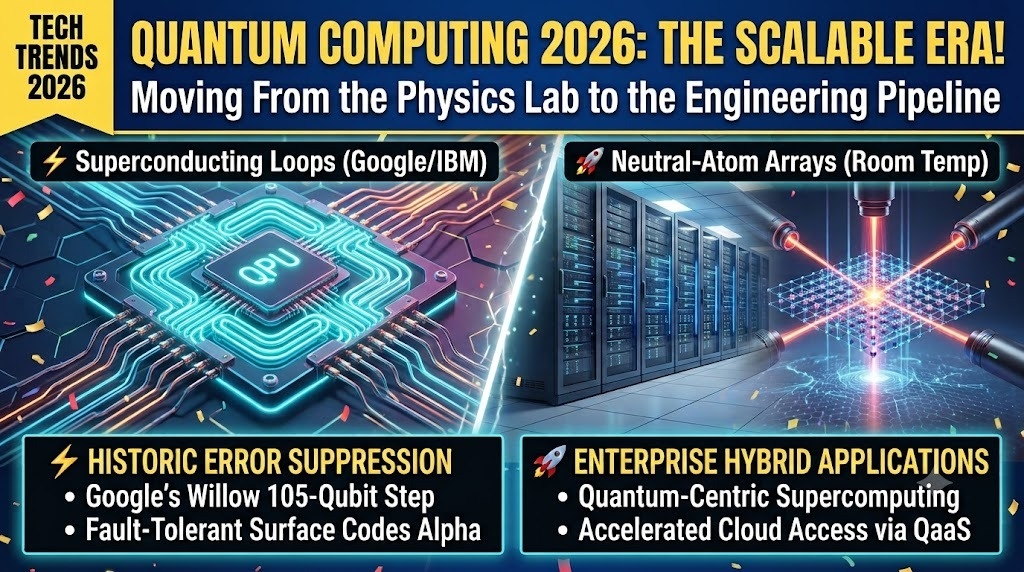
For years, quantum computing has been treated as a futuristic concept—a headline-grabbing topic reserved for deep-tech physics laboratories and long-term academic research. But 2026 has marked a major turning point. Leading physicists and data engineers state that quantum technology has officially reached its "transistor moment," successfully transitioning from theoretical experimentation into a scalable engineering discipline.
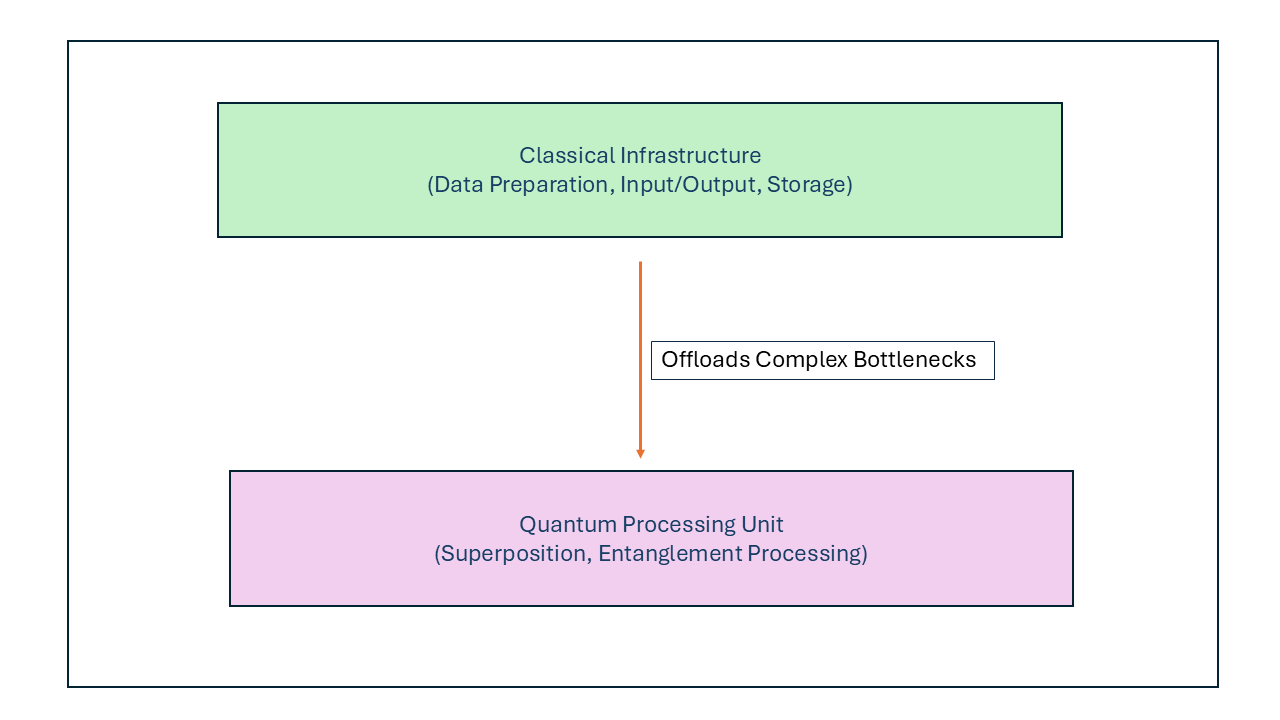
We aren't looking at a standalone machine that replaces your desktop. Instead, we are witnessing the dawn of hybrid supercomputing, where quantum processing units (QPUs) work hand-in-hand with traditional classical processors to tackle computational bottlenecks that once seemed impossible.
Here is your breakdown of the major breakthroughs shaping the quantum landscape right now.
🛠️ The Game-Changer: True Error Correction at Scale
Until recently, the biggest roadblock in quantum development was "noise". Qubits are highly sensitive to their environments; slight temperature shifts or stray electromagnetic waves cause "decoherence," destroying calculations before they finish.
This year, that barrier faced a massive structural shift:
- Google’s Willow Processor: Using a 105-physical-qubit superconducting architecture, Google demonstrated that adding more qubits can actually lower the overall system error rate. This marks the first physical proof that fault-tolerant scaling works exactly how theorists predicted.
- The Power of Surface Codes: Instead of relying on a single fragile physical qubit, modern systems arrange physical qubits into a strict rectangular grid. This grid acts collectively as a single, highly stable virtual logical qubit. If a few physical units misfire, the surrounding grid corrects the error in real-time.
This milestone shifts quantum computing from an unstable physics trial into an adaptable infrastructure roadmap, opening the door for predictable software scaling.
🏎️ The Industry Standard: Hybrid Quantum-Classical Architectures
A common misconception is that quantum computers will completely replace Silicon Valley’s traditional microchips. The current reality is far more practical: Quantum-centric Supercomputing.
Major semiconductor leaders, including AMD, are deploying unified frameworks where high-performance CPUs, GPUs, and advanced FPGAs serve as the foundational bedrock. In this setup, classical computers manage the massive bulk of data formatting, while complex combinatorial optimization or molecular equations are seamlessly offloaded to a connected quantum chip.
🔬 Breakthrough Hardware Diversity
While superconducting loops (used by IBM and Google) remain popular, alternate physical approaches are seeing rapid breakthroughs:
1. Neutral-Atom Arrays
Physicists have successfully used arrays of thousands of optical tweezers (tightly focused laser beams) to suspend and dynamically rearrange over 6,100 neutral atoms in real-time. Because these atoms can be physically shifted into 2D and 3D shapes, they offer incredible operational connectivity without needing the massive, ultra-cold dilution refrigerators required by superconducting chips.
2. Room-Temperature Platforms
Companies like SpinQ are advancing specialized Nuclear Magnetic Resonance (NMR) desktop and modular setups. Controlled via radio-frequency pulses, these systems utilize the intrinsic spin states of atomic nuclei. They provide stable, maintenance-free environments that run reliably at room temperature ideal for universities, research labs, and early software engineering development.
💼 Real-World Enterprise Applications
We are seeing the earliest clear instances of practical quantum advantage outperforming standard high-performance cloud clusters:
- Biotech & Drug Discovery: By running Variational Quantum Eigensolver (VQE) algorithms, researchers are simulating molecular bonds, protein folding, and chemical interactions at a fundamental atomic level. This dramatically reduces the time required to discover viable pharmaceutical compounds.
- Logistics & Grid Optimization: Major utility providers and shipping firms are testing quantum systems to solve exponential variable problems, such as managing smart-grid energy distribution and routing massive transport fleets globally.
🚀 How to Access Quantum Tech Today
You don't need a multi-million-dollar hardware lab to begin testing quantum code. Cloud ecosystems have opened up Quantum-as-a-Service (QaaS) models.
Platforms like AWS Braket, Google Quantum AI, IBM Quantum Network, and Microsoft Azure Quantum allow data teams, developers, and students to run experimental quantum circuits on physical hardware via a flexible, pay-as-a-go cloud billing model.
- Are you interested in exploring how quantum development languages like Qiskit work, or do you want to learn how your industry should prepare for post-quantum security shifts? Drop your thoughts and questions in the comments section below!