

Assam’s 2026 Deluge: The Science and Human Cost Behind the Six-Decade Flood

Assam’s 2026 Deluge: The Science and Human Cost Behind the Six-Decade Flood

Jagadeesh 2 min 07/29/2026News

Assam is battling its worst flood crisis in 60 years, impacting over 7.05 lakh people. The devastation is exceptionally high because the deluge struck historically "low-risk" or flood-safe zones like Charaideo, Jorhat, and Sivasagar. Because these elevated areas rarely flood, local communities and administrations had no active evacuation plans or flood-ready infrastructure in place.

Why the "Safe Zones" Flooded: Silt, Muck, and the New Normal

Scientists point to altered rainfall patterns as a climate-driven "new normal". Geographically, water from neighboring high-altitude hills rapidly drains into Assam’s low-lying plains.

A major trigger was extreme rainfall in Nagaland from July 18–20, which caused severe upstream landslides. The floodwaters arrived not as clean water, but as a rapid, violent torrent of thick clay and mud that swallowed homes in minutes. This was severely aggravated by riverbed aggradation—which raised Guwahati's river water level to a highly dangerous 47.76 meters—and local illegal coal mining and stone quarrying that destroyed natural forest buffers.

Nepalikhuti: Overnight Destruction and Community Resilience
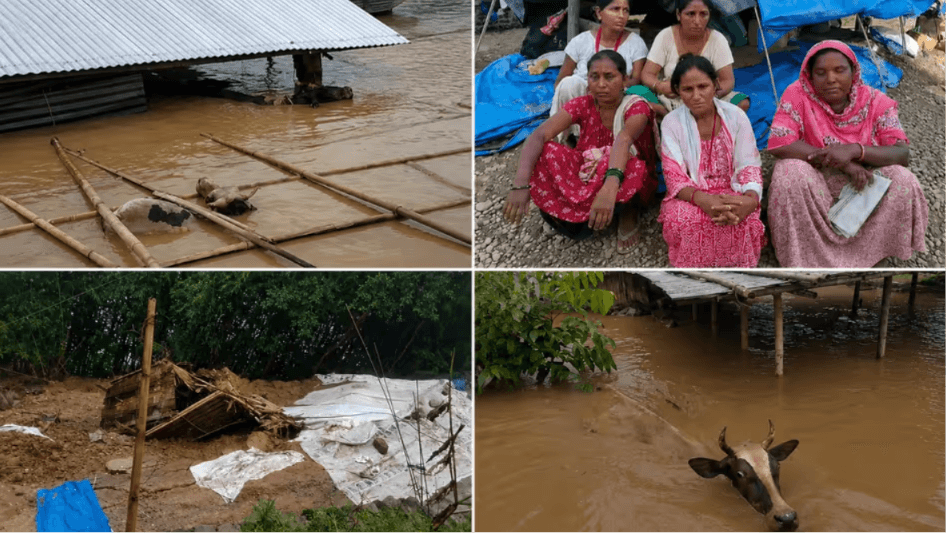
Entire villages, such as Nepalikhuti, vanished overnight under the heavy silt. Over 48,742 hectares of cropland were submerged, and 88,000 domestic livestock were affected, leaving rotting carcasses trapped in the thick mud. While the Indian Army initiated rescue operations on July 26, deep mud blocked their vehicles. Ultimately, local boatmen and neighbors carried out the majority of the life-saving rescues.

Kaziranga’s Silent Crisis: Wildlife’s Battle for Survival

At Kaziranga National Park, heavy flooding inundated at least six forest camps, forcing wild animals into a desperate fight for survival. To escape drowning, herds of elephants and deer began migrating across the busy National Highway 37 toward the higher ground of the Karbi Hills.

To protect the wildlife, forest guards (including dedicated female guards) halted highway traffic to let the herds cross safely without human-wildlife conflict.

Rebuilding Lives: Government Aid and Rehabilitation

Assam Chief Minister Himanta Biswa Sarma announced an additional Rs 5 lakh compensation from the Chief Minister's Relief Fund for families of the deceased, raising the total ex-gratia payment to Rs 9 lakh.

Additionally, an immediate Rs 15,000 interim relief is being distributed to every affected family in the worst-hit districts. Crucially, this aid has been expanded to cover traditionally excluded categories, such as government employees, ASHA workers, and Mid-Day Meal workers.


Table of Contents

Share Article

Related Blogs

Japan Earthquakes Explained
News

Japan Earthquakes Explained

Japan's experience with earthquakes demonstrates how science, engineering, and public preparedness can work together to reduce disaster risk. While earthquakes remain an unavoidable part of life due to the country's location along the Pacific Ring of Fire, continuous investment in monitoring systems, resilient infrastructure, and community education has made Japan one of the world's best-prepared nations for seismic hazards. Looking ahead, advances in artificial intelligence, satellite technology, geophysical research, and early warning systems are expected to further strengthen earthquake resilience. Although predicting earthquakes with exact precision remains beyond current scientific capability, ongoing innovation continues to improve preparedness and emergency response. What are your thoughts on Japan's earthquake preparedness and disaster management strategies? Do you think other earthquake-prone countries could adopt similar approaches? Share your views in the comments below, and if you found this article informative, don't forget to share it with friends and follow our blog for more insights into weather, geology, technology, and natural disasters.

5 min 7
Narendra Modi to Inaugurate Bhogapuram International Airport: A New Era for Andhra Pradesh's Aviation and Economy
News

Narendra Modi to Inaugurate Bhogapuram International Airport: A New Era for Andhra Pradesh's Aviation and Economy

Prime Minister Narendra Modi will inaugurate the Alluri Sitarama Raju International Airport at Bhogapuram on August 1, 2026, marking a significant infrastructure development for Andhra Pradesh. This new greenfield airport is poised to boost connectivity, tourism, trade, and economic growth for the North Andhra region by providing improved domestic and international flight options and facilitating cargo transportation. The project is expected to create numerous job opportunities and drive urban development, symbolizing Andhra Pradesh's commitment to progress and economic expansion.

3 min 10
Chenab River
News

Chenab River

The Chenab River is far more than a river flowing through the Himalayas—it is a lifeline for millions of people, a cornerstone of renewable energy development, and a symbol of the intricate relationship between geography, ecology, and international cooperation. From its glacial origins in Himachal Pradesh to its journey across Jammu and Kashmir and into Pakistan, the Chenab continues to shape landscapes, livelihoods, and sustainable development. As climate change, growing water demands, and infrastructure development reshape river systems worldwide, responsible management of the Chenab River will remain essential. Balancing hydropower, environmental conservation, disaster resilience, and international cooperation will be key to preserving this invaluable natural resource for future generations. What are your thoughts on the Chenab River and its role in India's environment, hydropower, and water security? Share your views in the comments below. If you found this article informative, don't forget to share it with friends and follow our blog for more insights into rivers, geography, climate, and environmental science.

5 min 7
Inside Dharmendra Pradhan’s Resignation Letter: The Real Reasons Behind the Education Minister’s Exit
News

Inside Dharmendra Pradhan’s Resignation Letter: The Real Reasons Behind the Education Minister’s Exit

Union Education Minister Dharmendra Pradhan has resigned amidst a national competitive examination crisis, citing concerns about "anti-national forces" infiltrating student protests and a desire to protect students' futures. His resignation letter also announced a significant policy shift: the NEET UG exam will move to a Computer-Based Test (CBT) mode next year to prevent paper leaks, and he defended the government's swift actions in investigating irregularities and conducting a re-exam.

3 min 9
Nashik District Floods 2026
News

Nashik District Floods 2026

Heavy monsoon rains have caused flooding in Nashik district, leading to overflowing rivers, rising dam levels, and road closures. Authorities are responding with flood alerts, evacuations, and continuous monitoring, while the situation highlights the increasing importance of climate change preparedness and improved flood management strategies.

5 min 20