

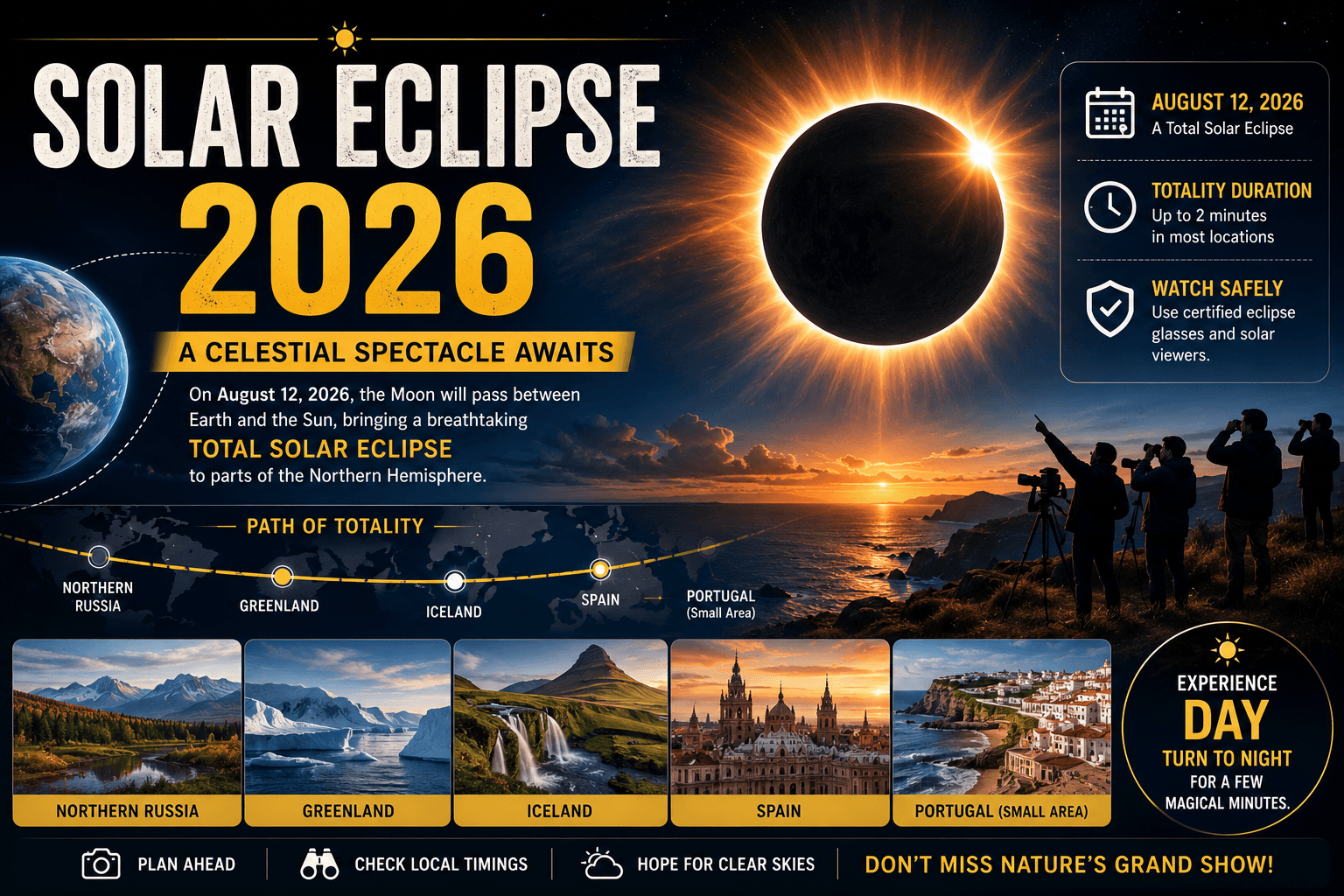
The sky will deliver one of its most spectacular events on August 12, 2026, when a total solar eclipse crosses parts of the Northern Hemisphere.
For people standing within the path of totality, the Moon will completely cover the Sun for a short time. Daylight will suddenly fade, temperatures may drop, and the Sun's normally hidden outer atmosphere, called the corona, will become visible.
The eclipse will be especially significant for parts of Greenland, Iceland, Spain, Russia and a small area of Portugal.
What Is a Total Solar Eclipse?
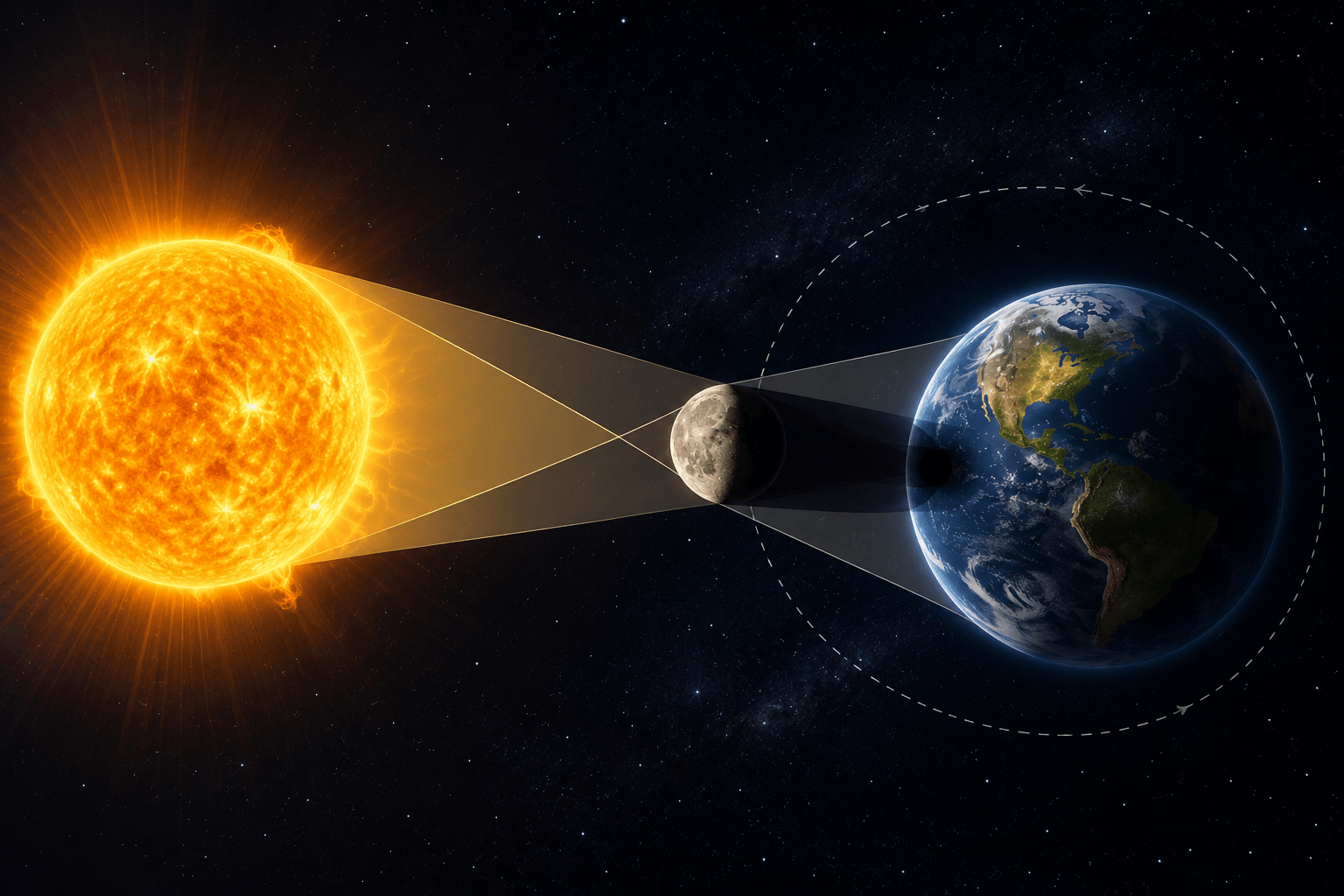
A solar eclipse happens when the Moon passes between Earth and the Sun.
When the alignment is precise enough, the Moon blocks the Sun and casts its shadow onto Earth.
People located inside the darkest part of that shadow, called the umbra, experience a total solar eclipse. People farther away in the lighter shadow, called the penumbra, see only part of the Sun covered.
When Is the 2026 Total Solar Eclipse?
The total solar eclipse will occur on:
Date: August 12, 2026
Globally, the partial eclipse begins at approximately 15:34 UTC, while totality first begins around 16:58 UTC. The eclipse reaches its global maximum at approximately 17:46 UTC, with the final partial phase ending around 19:58 UTC. Exact viewing times vary significantly depending on location.
Where Will the Total Eclipse Be Visible?
The path of totality will cross a relatively narrow part of Earth.
According to NASA, totality will pass across parts of:
- Northern Russia
- Greenland
- Iceland
- Spain
- A small part of Portugal
The path will also cross sections of the Arctic and Atlantic oceans. People outside this narrow path may still experience an impressive partial solar eclipse.Much of Europe, most of Canada, northwestern Africa and parts of the United States will see at least part of the Sun covered.
Why Spain and Iceland Are Special
The eclipse offers particularly interesting viewing conditions in Europe. In Iceland, totality will occur during the late afternoon or early evening. In Spain, it will happen close to sunset.
This means observers in Spain could potentially experience the unusual combination of a total solar eclipse and a low evening Sun, depending on their exact location and weather conditions.The event is also notable because it brings totality back to mainland Europe for the first time since 1999.
How Long Will Totality Last?
Totality will be relatively short. NASA says that for most locations within the path, the Sun will remain completely covered for less than two minutes.
Locations near the center of the eclipse path in areas such as Greenland, northern Russia and the North Atlantic can experience a little longer, although maximum totality will still remain below about two and a half minutes.During these moments, the sky can become dramatically darker and the Sun's corona becomes visible around the Moon.
What Makes a Total Solar Eclipse So Special?
The Sun is roughly 400 times wider than the Moon, but it is also roughly 400 times farther away from Earth. Because of this remarkable relationship, the Sun and Moon appear almost the same size in our sky.When their positions align correctly, the Moon can temporarily cover the Sun's bright surface almost perfectly.The result is one of nature's most impressive astronomical sights.
Scientists Will Study the Eclipse
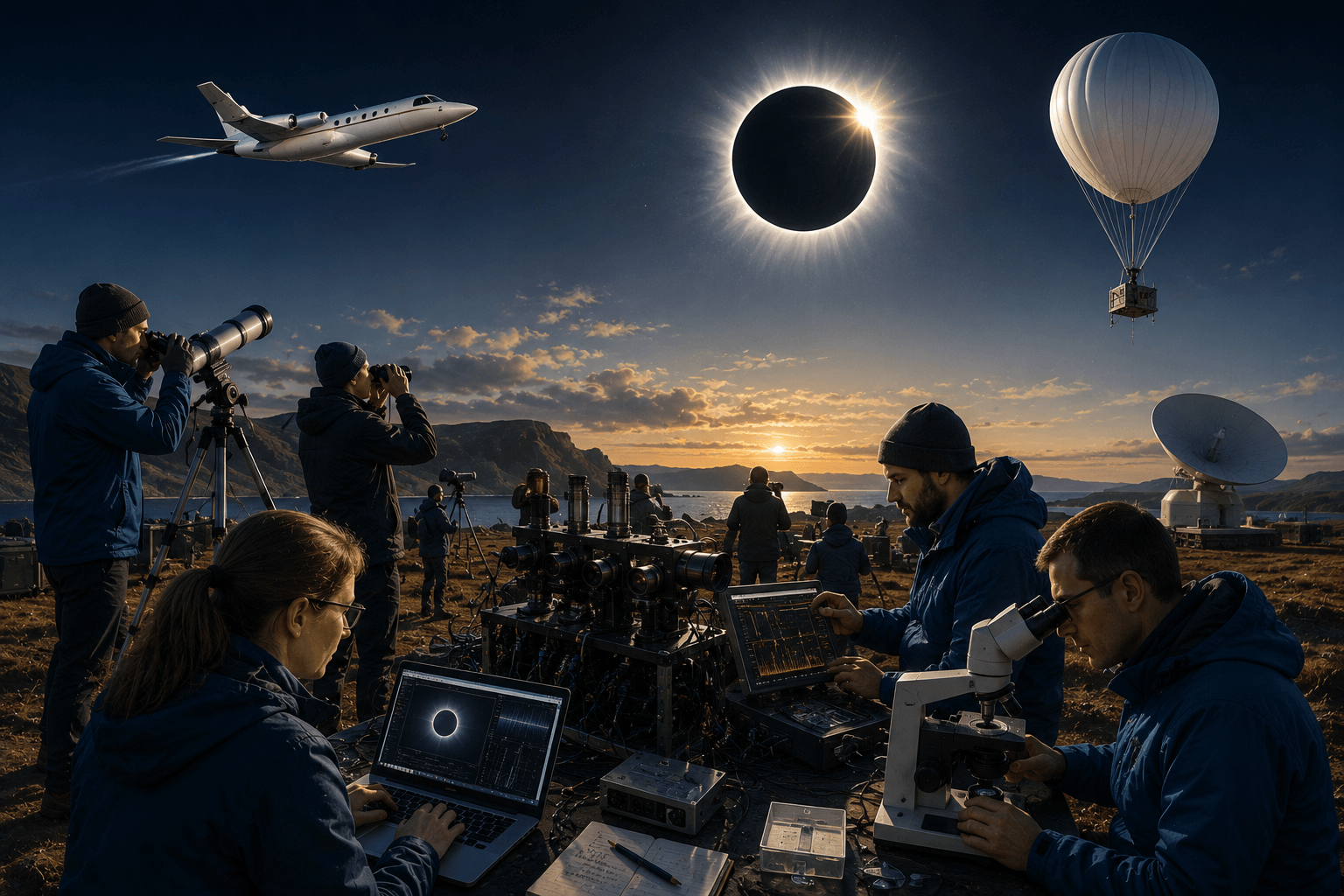
Solar eclipses are not only spectacular events. They also provide valuable opportunities for scientific research. NASA-supported teams plan to study the August 2026 eclipse using a high-altitude aircraft and scientific balloons.Scientists will investigate the Sun's corona and examine how the sudden disappearance of sunlight affects Earth's atmosphere. Student teams are also expected to launch balloons in Iceland and Spain before, during and after the eclipse.
How to Watch the Eclipse Safely
Looking directly at the Sun can cause serious eye damage. During the partial phases, observers must use proper solar eclipse glasses or certified handheld solar viewers. Regular sunglasses are not safe for viewing the Sun.
Cameras, telescopes and binoculars also require appropriate solar filters placed over the front of their optics. Looking through these devices without the correct filter can cause severe eye injury.
Only during the brief period of complete totality, when the Sun's bright surface is entirely covered, can observers within the path of totality look without solar viewing protection. Eye protection must be put back on as soon as the bright Sun begins to reappear.
A Major Astronomical Event of 2026
The August 12, 2026 total solar eclipse will be one of the year's most memorable astronomical events.
From the dramatic landscapes of Greenland and Iceland to an eclipse occurring near sunset in Spain, millions of people will have an opportunity to experience either totality or a partial eclipse.
For scientists, it provides precious minutes to study the Sun and Earth's atmosphere. For everyone else, it offers something much simpler: a rare opportunity to watch the Moon temporarily turn day into darkness.