


Advanced Machine Learning and Deep Learning
by UptoSkills Team
Missions
14
Quests
82
Games
25
XP
750
Coins
35
Certificate optional — ₹499, or ₹199 on Pro
Key Benefits
Earn XP & Level Up
Gain 750 XP to unlock badges and achievements
Collect Coins
Earn 35 coins to redeem rewards
Professional Certificate
QR-verified and recruiter-checkable — ₹499, or ₹199 on Pro
Unlock Achievements
Complete challenges and earn exclusive badges
Certificate Preview
Finish the league and this is what you walk away with.
We'll post you a printed copy — free.
Tick one box at checkout and it ships anywhere in India in 14–21 days. Almost nobody here does this free.

Learn and Earn Platform
Certificate of Completion
This is to certify that
Your Name
has successfully completed the comprehensive
"Advanced Machine Learning and Deep Learning"
League Program
This certificate acknowledges the successful completion of all required coursework and assessments. The recipient has demonstrated proficiency in the subject matter.
September 4, 2026

VERIFIED & AUTHENTIC
Official Seal
UTS-LEAGUE-PREVIEW
Scan to verify
✨ QR-verified · high-quality PDF
Every lesson, quest and game here is free. Forever.
Standard
₹499
one-time
With Pro
₹199
per certificate
So why isn't the certificate free? One anybody can print is worth nothing to a recruiter. The fee covers evaluation, QR-backed verification and lifetime hosting — that's what makes it checkable.
Hall of Fame
About This League
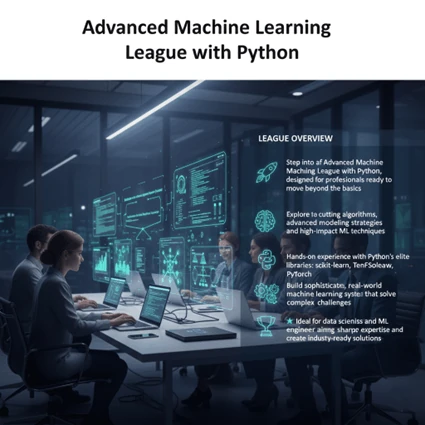
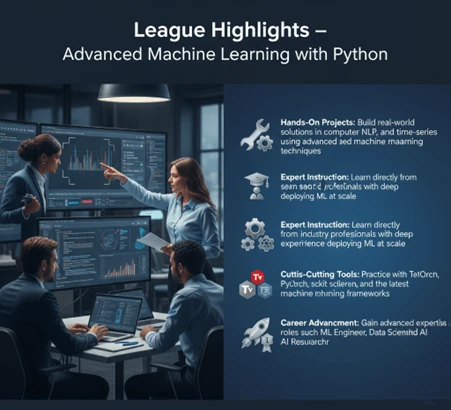
This comprehensive league delves into advanced machine learning and deep learning concepts, equipping students with cutting-edge techniques. It covers sophisticated algorithms and practical implementation strategies essential for modern AI applications. The curriculum is designed for individuals aiming to excel in competitive placement and internship opportunities.
What you will learn
Upon completion, you will be able to:
- Implement advanced regression and classification models using ensemble methods and gradient boosting.
- Apply unsupervised learning techniques for clustering, dimensionality reduction, and anomaly detection.
- Build and train complex deep learning models including CNNs, RNNs, and Transformers for diverse tasks.
- Develop generative models using GANs and explore reinforcement learning for sequential decision-making.
- Interpret and explain complex ML models using XAI techniques and deploy them into production environments.
What this league covers
| Module | What it covers |
|---|---|
| Module 1: Foundations & Python Optimization for ML | Optimizing NumPy, Pandas, and Cython for ML; essential linear algebra refresher and Python profiling. |
| Module 2: Advanced Regression Techniques | Polynomial regression, Ridge, Lasso, Elastic Net, and advanced evaluation metrics for regression problems. |
| Module 3: Advanced Classification Techniques | SVMs, kernel methods, ensemble techniques like XGBoost, and strategies for imbalanced datasets. |
| Module 4: Unsupervised Learning Techniques | Advanced clustering (DBSCAN), dimensionality reduction (PCA, t-SNE), and anomaly detection (Isolation Forest). |
| Module 5: Deep Learning Fundamentals | Neural network architectures, backpropagation, optimization algorithms, and regularization with TensorFlow/Keras. |
| Module 6: Convolutional Neural Networks (CNNs) | CNN architectures (ResNet), object detection (YOLO), image segmentation (U-Net), and transfer learning. |
| Module 7: Recurrent Neural Networks (RNNs) | LSTMs, GRUs, sequence-to-sequence models, attention mechanisms, and time series analysis with RNNs. |
| Module 8: Natural Language Processing (NLP) | Word embeddings (Word2Vec), Transformers (BERT, GPT), sentiment analysis, and question answering. |
| Module 9: Generative Adversarial Networks (GANs) | GAN theory, DCGANs, WGANs, conditional GANs, and applications in image generation and style transfer. |
| Module 10: Reinforcement Learning (RL) | Markov Decision Processes, Q-Learning, Deep Q-Networks (DQN), and Policy Gradient methods. |
| Module 11: Bayesian Machine Learning | Bayesian inference, Gaussian Processes, Variational Inference, and Markov Chain Monte Carlo (MCMC) methods. |
| Module 12: Time Series Analysis and Forecasting | ARIMA models, State Space Models (Kalman Filters), and deep learning approaches for time series. |
| Module 13: Model Interpretability and Explainability (XAI) | Feature importance, SHAP values, LIME, and partial dependence plots for understanding model decisions. |
| Module 14: Productionizing Machine Learning Models | Model deployment with Docker and Kubernetes, MLOps pipelines, and model monitoring strategies. |
Students will be prepared for MLOps Fundamentals or further specialization in Machine Learning with Python.
A look inside


Prerequisites
- Comfortable writing Python, including lists, dictionaries and functions.
- Understand supervised learning, training/test splits and overfitting.
- Comfortable with linear algebra and calculus notation.
- Have trained at least one model end to end.
Learning Objectives
- Implement and evaluate advanced deep learning models, including transformers and generative adversarial networks (GANs), using TensorFlow or PyTorch for complex tasks such as natural language processing and image synthesis, achieving state-of-the-art performance metrics.
- Analyze and compare the theoretical foundations and practical limitations of various advanced machine learning algorithms, such as Bayesian optimization, reinforcement learning, and graph neural networks, justifying the choice of algorithm for specific real-world problems.
- Create and optimize custom machine learning pipelines using advanced feature engineering techniques, hyperparameter tuning strategies, and model ensembling methods to maximize predictive accuracy and robustness on high-dimensional and noisy datasets.
- Understand and apply advanced techniques for addressing common challenges in machine learning, including handling imbalanced datasets, mitigating bias and fairness issues, and ensuring model interpretability and explainability.
- Develop and implement distributed machine learning solutions using cloud-based platforms such as AWS SageMaker or Google Cloud AI Platform, capable of scaling to handle large datasets and complex models efficiently.
- Evaluate and critique published research papers in advanced machine learning, identifying novel contributions, limitations, and potential areas for future research, and presenting the findings effectively.
Earn XP • Collect Coins • Unlock Achievements