

Machine Learning with Python
by UptoSkills Team
Missions
14
Quests
96
Games
42
XP
700
Coins
35
Certificate optional — ₹499, or ₹199 on Pro
Key Benefits
Earn XP & Level Up
Gain 700 XP to unlock badges and achievements
Collect Coins
Earn 35 coins to redeem rewards
Professional Certificate
QR-verified and recruiter-checkable — ₹499, or ₹199 on Pro
Unlock Achievements
Complete challenges and earn exclusive badges
Certificate Preview
Finish the league and this is what you walk away with.
We'll post you a printed copy — free.
Tick one box at checkout and it ships anywhere in India in 14–21 days. Almost nobody here does this free.

Learn and Earn Platform
Certificate of Completion
This is to certify that
Your Name
has successfully completed the comprehensive
"Machine Learning with Python"
League Program
This certificate acknowledges the successful completion of all required coursework and assessments. The recipient has demonstrated proficiency in the subject matter.
September 4, 2026

VERIFIED & AUTHENTIC
Official Seal
UTS-LEAGUE-PREVIEW
Scan to verify
✨ QR-verified · high-quality PDF
Every lesson, quest and game here is free. Forever.
Standard
₹499
one-time
With Pro
₹199
per certificate
So why isn't the certificate free? One anybody can print is worth nothing to a recruiter. The fee covers evaluation, QR-backed verification and lifetime hosting — that's what makes it checkable.
Hall of Fame
About This League
Machine learning is a core competency for data-driven roles in the tech industry. This comprehensive league provides a structured pathway to understanding and applying key ML algorithms and techniques using Python. It's designed for students aiming to enhance their skills for internships and placements.
What you will learn
Upon completing this league, you will be able to:
- Implement various regression and classification models in Python for predictive analytics.
- Perform effective feature engineering and selection to improve model performance.
- Apply unsupervised learning techniques for clustering and dimensionality reduction.
- Build and tune machine learning pipelines for efficient model development.
- Explain model predictions using interpretability techniques and deploy models to production environments.
What this league covers
| Module | What it covers |
|---|---|
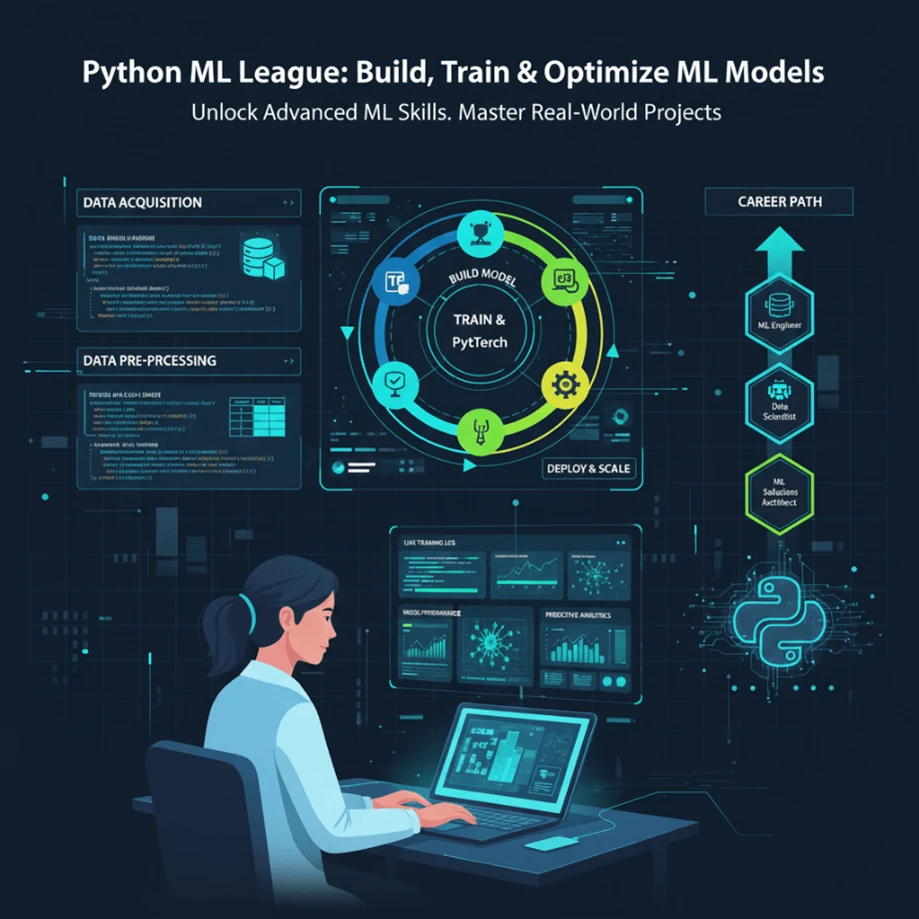
| Module 1: Python for Machine Learning Refresher | Essential Python libraries like NumPy and Pandas, plus data visualization with Matplotlib and Seaborn. |
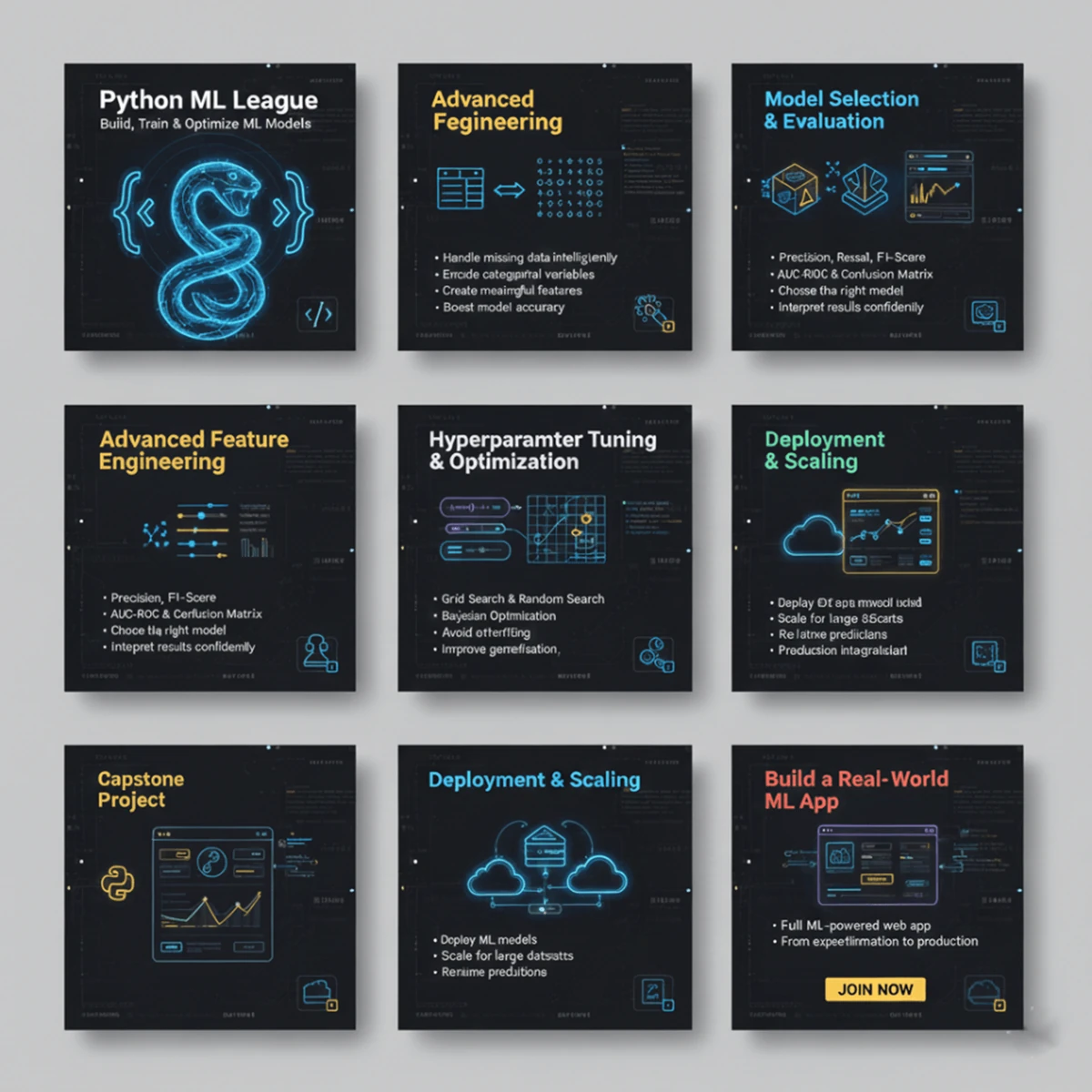
| Module 2: Feature Engineering Foundations | Handling missing data, encoding categorical variables, feature scaling, interaction, and polynomial features. |
| Module 3: Regression Models: Linear and Beyond | Implementing Linear Regression, Polynomial Regression, regularization techniques, and evaluation metrics. |
| Module 4: Classification Models: Mastering the Basics | Applying Logistic Regression, KNN, and SVM, alongside classification evaluation and probability calibration. |
| Module 5: Tree-Based Models: Decision Trees and Ensemble Methods | Building Decision Trees, Random Forests, Gradient Boosting, XGBoost, LightGBM, and CatBoost. |
| Module 6: Model Selection and Hyperparameter Tuning | Understanding the bias-variance tradeoff, cross-validation, and optimization techniques like Grid Search. |
| Module 7: Unsupervised Learning: Clustering Techniques | Applying K-Means, Hierarchical, and DBSCAN clustering, with methods for evaluating cluster performance. |
| Module 8: Dimensionality Reduction: PCA and More | Utilizing PCA, LDA, t-SNE, and UMAP for reducing feature spaces and autoencoders. |
| Module 9: Model Explainability (Interpretability) | Understanding model behavior with Permutation Importance, SHAP, LIME, and PDP plots. |
| Module 10: Time Series Analysis and Forecasting | Decomposing time series, applying ARIMA and SARIMA models, and using Prophet for forecasting. |
| Module 11: Advanced Feature Engineering Techniques | Exploring Target Encoding, automated feature generation with Featuretools, and text data features. |
| Module 12: Handling Imbalanced Datasets | Techniques for imbalanced data including SMOTE, resampling, and anomaly detection. |
| Module 13: Building ML Pipelines with Scikit-learn | Creating end-to-end ML workflows, custom transformers, and parallel processing in pipelines. |
| Module 14: Deploying Machine Learning Models | Model persistence, building APIs with Flask, containerization with Docker, and cloud deployment. |
You will be equipped to tackle complex ML challenges and contribute to production systems. MLOps Fundamentals is a natural next step.
A look inside

Prerequisites
- Comfortable writing Python, including lists, dictionaries and functions.
- Comfortable with mean, median, distributions and basic probability.
- Understand supervised learning, training/test splits and overfitting.
Learning Objectives
- Implement and optimize at least three different machine learning models (e.g., Regression, Classification, Clustering) using Python's scikit-learn library on real-world datasets, achieving a minimum performance improvement of 15% as measured by a relevant evaluation metric (e.g., F1-score, RMSE).
- Create and deploy a complete machine learning pipeline, including data preprocessing, feature engineering, model training, hyperparameter tuning, and model evaluation, using Python and relevant libraries like Pandas and scikit-learn, and document each step in a reproducible manner.
- Analyze the performance of different machine learning models using techniques such as cross-validation, learning curves, and confusion matrices, and justify the selection of the best model based on both performance metrics and business requirements.
- Understand and apply advanced optimization techniques such as grid search, random search, and Bayesian optimization to fine-tune the hyperparameters of a machine learning model, demonstrably improving its performance by at least 10% compared to default parameters.
- Implement at least two different feature selection methods (e.g., Recursive Feature Elimination, SelectKBest) to reduce dimensionality and improve model performance, while also analyzing the impact of feature selection on model interpretability.
Earn XP • Collect Coins • Unlock Achievements