

Digital Electronics Fundamentals
by UptoSkills Team
Missions
6
Quests
34
Games
16
XP
500
Coins
35
Certificate optional — ₹399, or ₹199 on Pro
Key Benefits
Earn XP & Level Up
Gain 500 XP to unlock badges and achievements
Collect Coins
Earn 35 coins to redeem rewards
Professional Certificate
QR-verified and recruiter-checkable — ₹399, or ₹199 on Pro
Unlock Achievements
Complete challenges and earn exclusive badges
Certificate Preview
Finish the league and this is what you walk away with.
We'll post you a printed copy — free.
Tick one box at checkout and it ships anywhere in India in 14–21 days. Almost nobody here does this free.
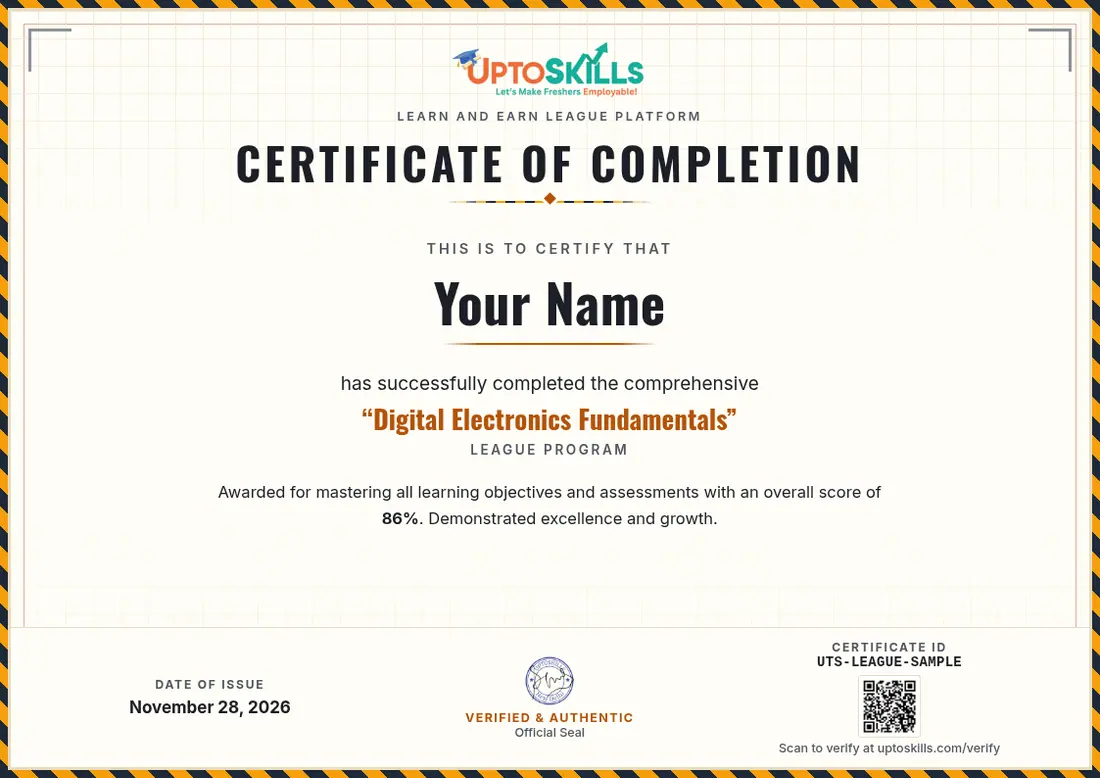
✨ QR-verified · high-quality PDF
Every lesson, quest and game here is free. Forever.
Standard
₹399
one-time
With Pro
₹199
per certificate
So why isn't the certificate free? One anybody can print is worth nothing to a recruiter. The fee covers evaluation, QR-backed verification and lifetime hosting — that's what makes it checkable.
Hall of Fame
About This League
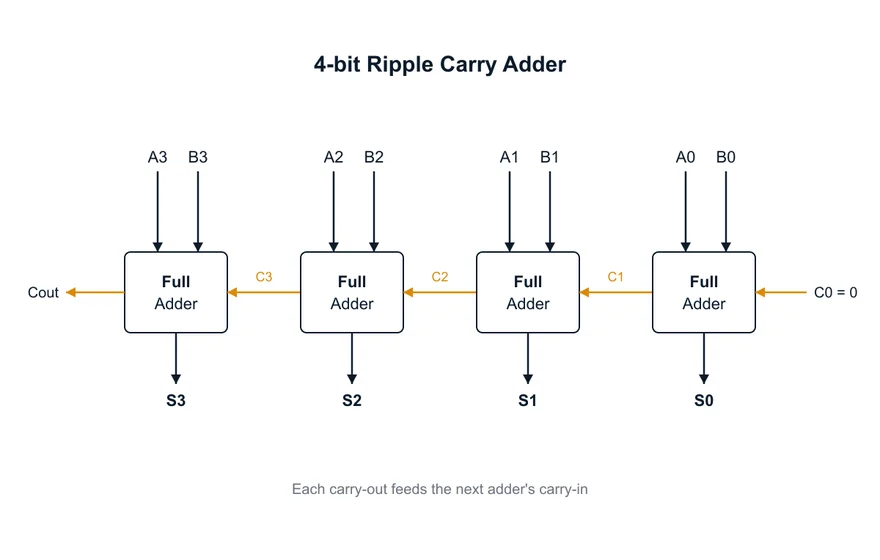
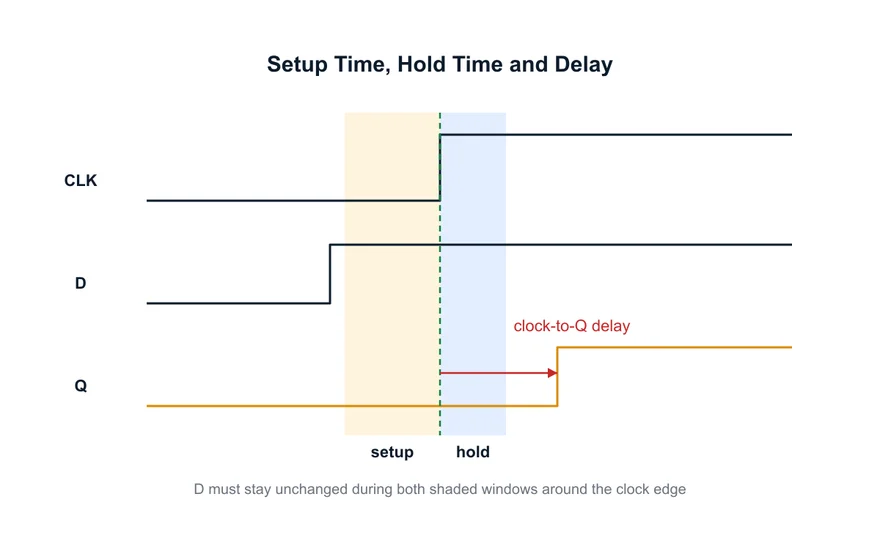
Digital electronics is the base of every chip, processor and embedded device. This League takes you from binary numbers to state machines, with gate diagrams, truth tables, K-maps and timing waveforms, and prepares you for Verilog and VLSI design.
What you will learn
After completing this League, you will be able to:
- Convert between binary, octal, hexadecimal and decimal, and work with signed numbers.
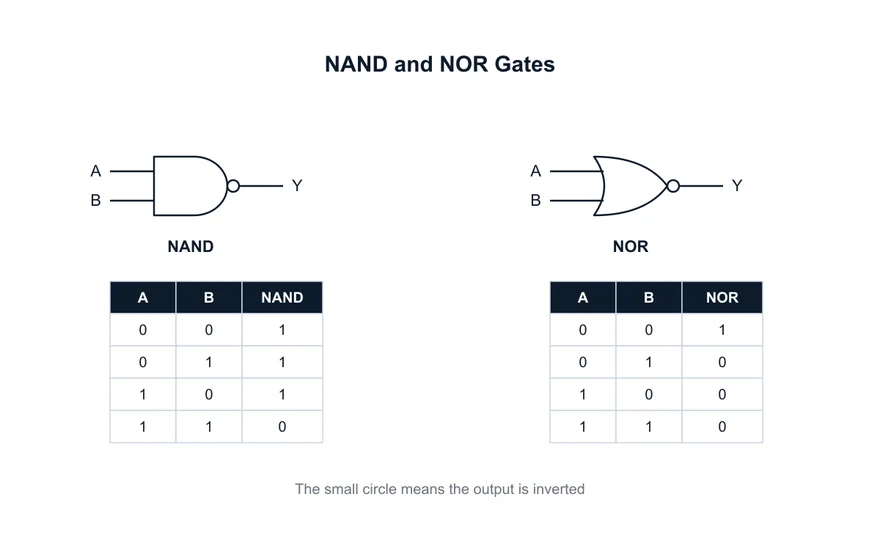
- Read and use logic gates, truth tables and Boolean laws, including De Morgan's theorems.
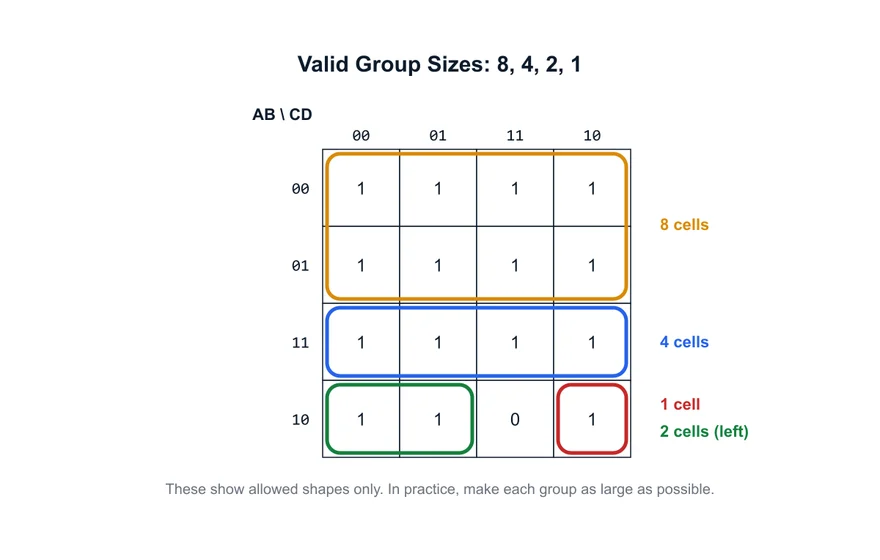
- Simplify logic expressions with Karnaugh maps.
- Understand adders, multiplexers, decoders and comparators.
- Explain how latches, flip-flops, shift registers and counters store and count.
- Design simple state machines and understand setup time, hold time and clock skew.
What this League covers
ModuleWhat it coversNumber Systems and Binary CodesAnalog and digital signals, base conversions, binary arithmetic, two's complement, BCD, Gray code and ASCII.Logic Gates and Boolean AlgebraBasic and universal gates, Boolean laws, De Morgan's theorems, SOP and POS forms.Karnaugh Maps and SimplificationTwo, three and four variable maps, grouping rules and don't care conditions.Combinational CircuitsAdders, subtractors, multiplexers, demultiplexers, encoders, decoders and comparators.Sequential CircuitsLatches, clock signals, flip-flops, shift registers and counters.State Machines and TimingMoore and Mealy machines, state diagrams and tables, timing and metastability.
Who this League is for
ECE, EEE and computer science students, and anyone who wants to move into VLSI or embedded systems. No earlier electronics knowledge is needed.
A look inside
Prerequisites
- No earlier electronics knowledge needed; knowing what voltage means helps
- Familiarity with basic arithmetic and algebraic operations
- Ability to follow simple step-by-step instructions
- Comfort with using a computer for learning and basic problem-solving
Learning Objectives
- Understand the basic building blocks of digital electronics, including logic gates (AND, OR, NOT, XOR, NAND, NOR) and their truth tables.
- Implement simple combinational logic circuits using logic gates for basic arithmetic operations (e.g., half adder, full adder).
- Analyze the operation of fundamental sequential logic circuits, including flip-flops (SR, D, JK, T) and their state transitions.
- Describe the function and applications of common digital components such as multiplexers, demultiplexers, encoders, and decoders.
- Apply Boolean algebra principles to simplify and optimize digital logic expressions.
- Differentiate between combinational and sequential logic circuits and provide examples of their use in embedded systems.
Earn XP • Collect Coins • Unlock Achievements