

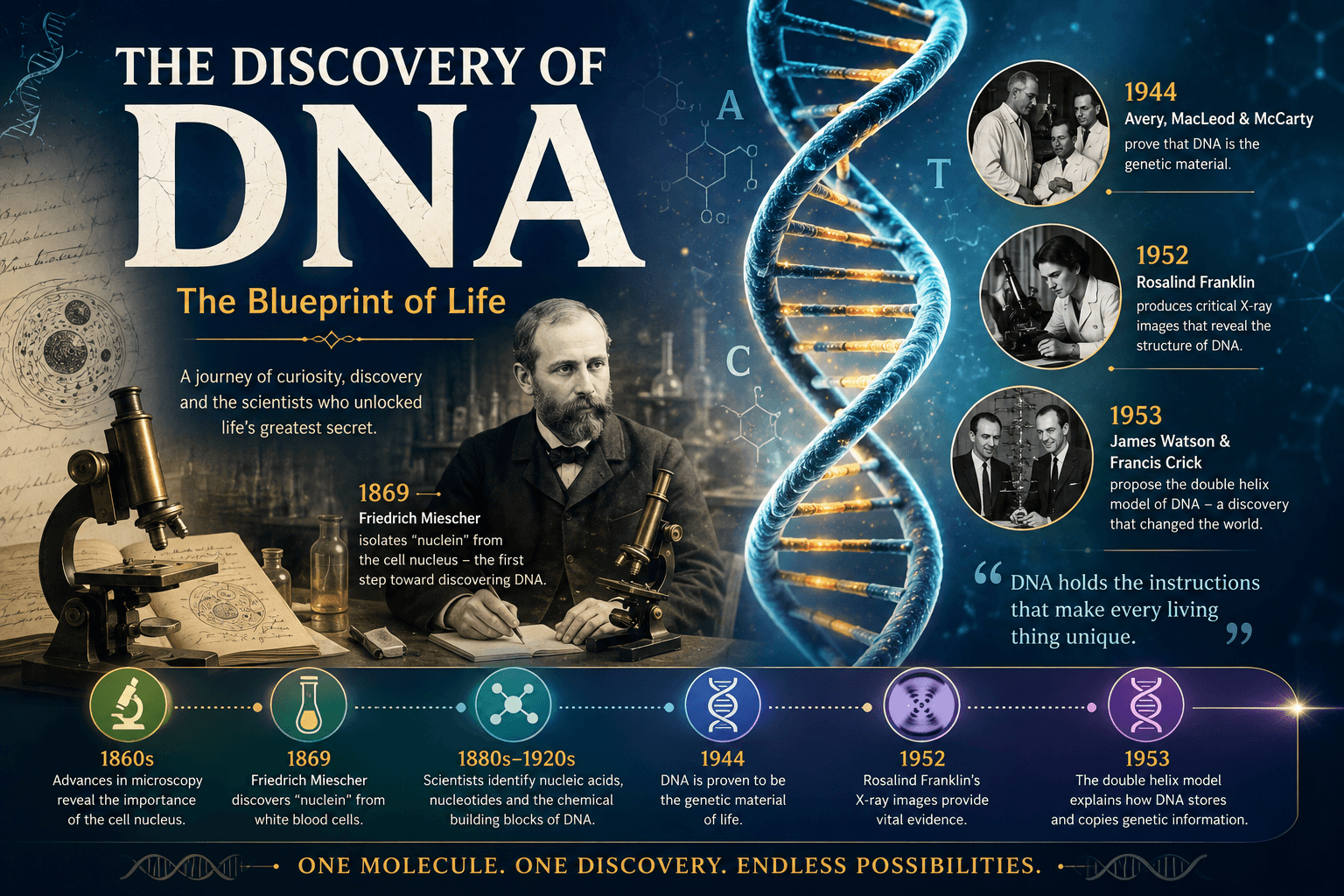
The discovery of DNA is one of the greatest milestones in the history of science. Today, we know DNA as the molecule that carries the genetic instructions for every living organism. It determines everything from eye color and blood type to how our bodies grow and function.
However, this understanding did not happen overnight. The story of DNA spans nearly a century, involving brilliant scientists, groundbreaking experiments, and revolutionary discoveries. Let's explore how the mystery of life's blueprint was gradually uncovered.
The Beginning of Cellular Science
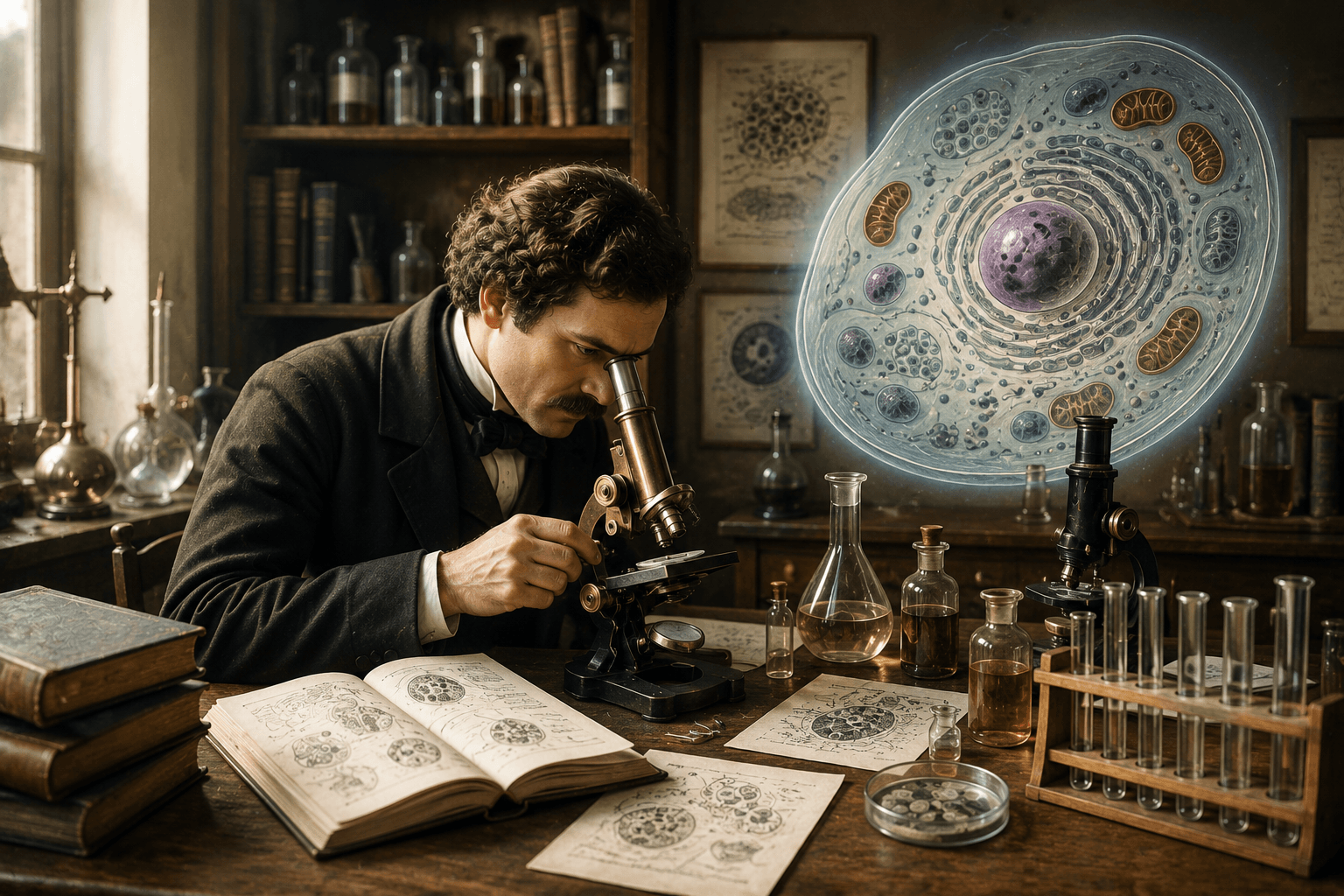
During the mid-1800s, scientists were making remarkable progress in studying cells through improved microscopes. They discovered that every living organism is made up of cells and that each cell contains a nucleus.
Although researchers knew the nucleus existed, they had no idea what its purpose was. Most scientists believed that proteins, because of their complexity, were responsible for carrying hereditary information.
No one suspected that another molecule hidden inside the nucleus would become one of the most important discoveries in biology.
Friedrich Miescher Discovers "Nuclein"
The first major breakthrough came in 1869.
Swiss scientist Friedrich Miescher, while working at the University of Tübingen in Germany, studied white blood cells collected from used surgical bandages.
Using careful chemical techniques, he isolated a strange substance from the cell nucleus. Unlike proteins, it contained a large amount of phosphorus and behaved differently in laboratory tests.
Miescher named this newly discovered material "nuclein" because it came from the nucleus.
Although he had discovered DNA, he did not realize its true importance. At the time, no one knew that nuclein carried genetic information.
Scientists Learn More About Nucleic Acids
Over the following decades, researchers continued studying nuclein.
Scientists found that it consisted of molecules called nucleic acids, along with proteins. Gradually, they discovered that nucleic acids were built from smaller units called nucleotides.
Each nucleotide contains three parts:
- A sugar molecule
- A phosphate group
- A nitrogen base
Researchers also identified the four nitrogen bases that make up DNA:
- Adenine (A)
- Thymine (T)
- Cytosine (C)
- Guanine (G)
These discoveries revealed the chemical structure of DNA, but its biological role remained a mystery.
DNA Becomes the Genetic Material
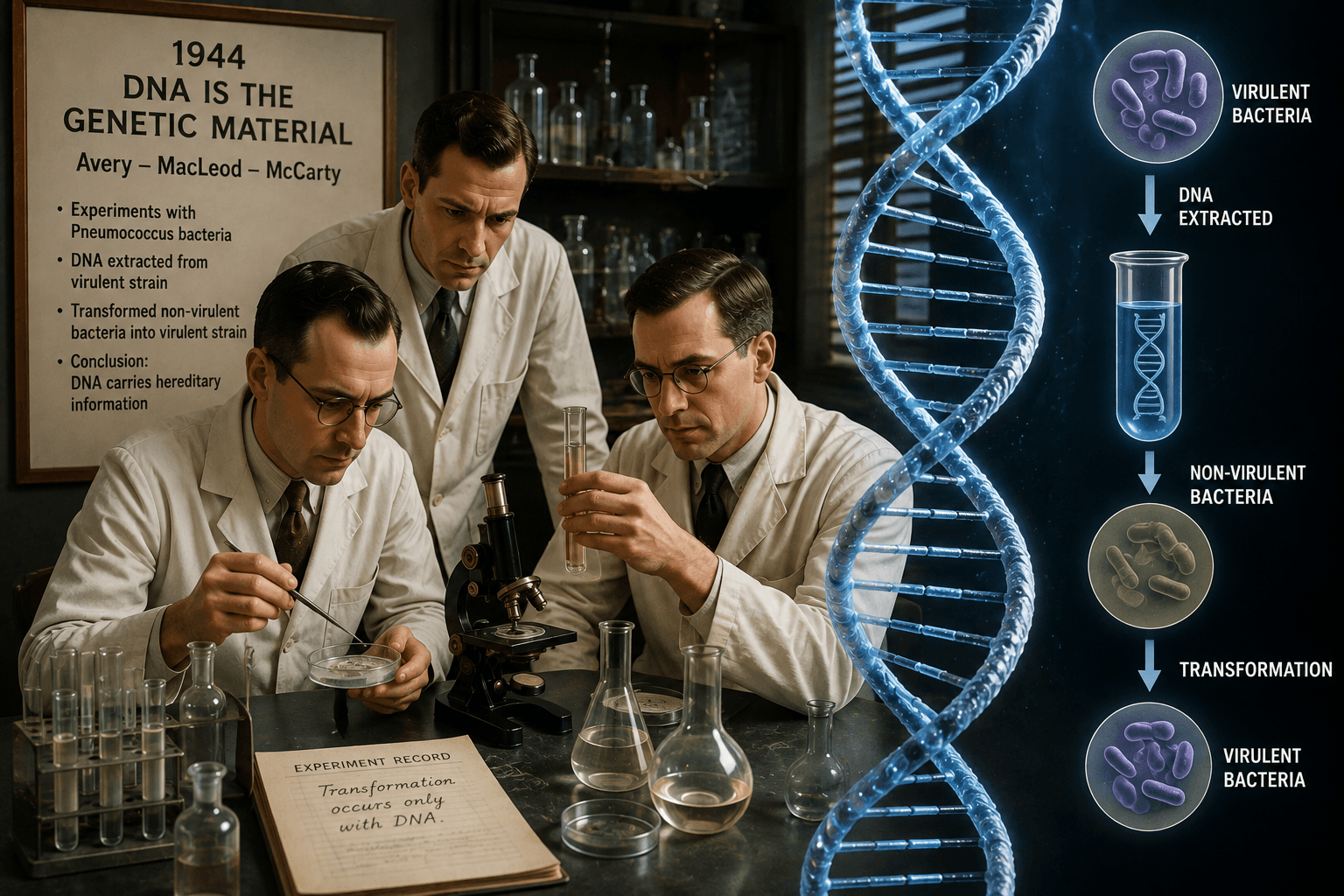
For many years, scientists believed proteins carried hereditary information because proteins were more chemically complex than DNA.
This belief changed in 1944, when scientists Oswald Avery, Colin MacLeod, and Maclyn McCarty demonstrated that DNA, not protein, was responsible for transferring genetic traits in bacteria.
Their experiments provided strong evidence that DNA is the molecule of inheritance.
This marked a turning point in genetics.
The Famous Double Helix Discovery
The biggest breakthrough came in 1953.
Scientists James Watson and Francis Crick proposed the famous double helix structure of DNA.
Their model explained how DNA stores information and how it copies itself during cell division.
Their discovery relied heavily on Rosalind Franklin's X-ray diffraction images, especially the famous Photo 51, as well as important work by Maurice Wilkins.
Together, these contributions transformed biology forever.
Why the Double Helix Was Revolutionary
The double helix showed that DNA is made of two strands twisted around each other.
The nitrogen bases pair in a specific way:
- Adenine pairs with Thymine (A-T)
- Cytosine pairs with Guanine (C-G)
These base pairs allow DNA to copy itself accurately whenever cells divide.
This simple pairing system explained how genetic information could be passed from one generation to the next.
How the Discovery Changed the World
Understanding DNA opened the door to entirely new fields of science.
Today, DNA is used in:
- Medical diagnosis
- Cancer research
- Genetic engineering
- Forensic investigations
- DNA fingerprinting
- Paternity testing
- Evolutionary studies
- Agriculture and crop improvement
- Personalized medicine
Modern technologies such as gene sequencing and CRISPR gene editing are possible because scientists first understood DNA.
The Legacy of DNA Discovery
The discovery of DNA was not the achievement of a single scientist.
It was the result of decades of research, with each scientist adding another piece to the puzzle.
From Friedrich Miescher's discovery of nuclein in 1869 to Watson and Crick's double helix model in 1953, the journey transformed our understanding of life itself.
Today, DNA remains at the heart of biology, medicine, and biotechnology, continuing to shape discoveries that improve human health and deepen our understanding of the living world.
Conclusion
The discovery of DNA is one of the most remarkable scientific stories in history.
What began with the isolation of an unknown substance inside the cell nucleus eventually revealed the molecule responsible for heredity and life itself.