

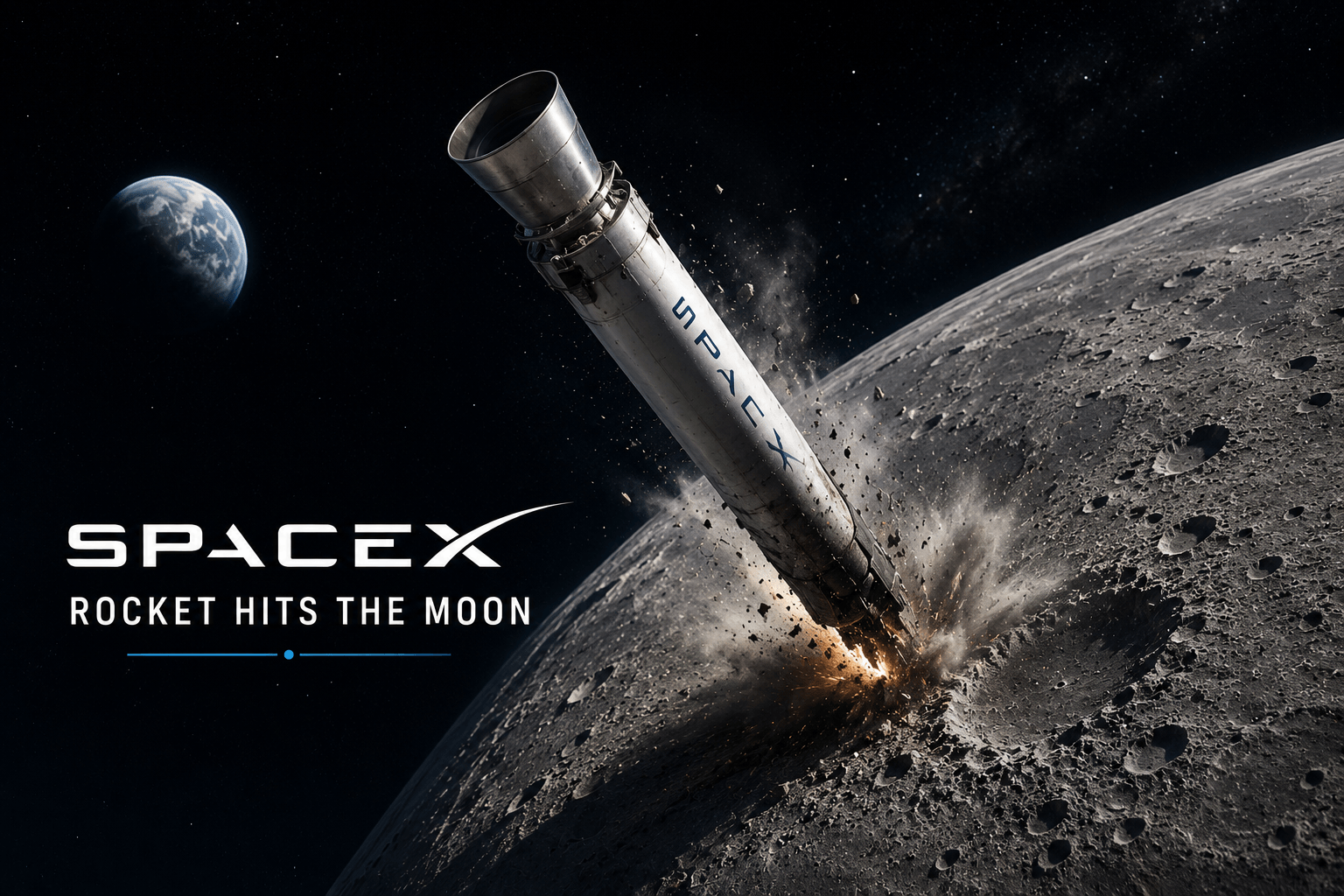
A discarded SpaceX Falcon 9 upper stage crashed into the Moon on August 5, 2026, after travelling through space for around 18 months. The unusual event attracted attention because it shows what can happen to rocket hardware after completing missions beyond Earth.
Where Did the Rocket Come From?
The Falcon 9 was launched in January 2025 carrying two commercial lunar spacecraft: Firefly Aerospace's Blue Ghost and ispace's RESILIENCE lander. After successfully releasing the spacecraft, the rocket's upper stage remained in space. Unlike the reusable Falcon 9 first-stage booster, the upper stage was not designed to return and land on Earth.
How Did It Hit the Moon?
- After completing its mission, the rocket stage continued travelling through space.
- Over time, gravitational forces from the Earth, Moon and Sun influenced its path.
- Eventually, the stage was placed on a collision course with the Moon.
- It reportedly struck near the Einstein crater region at roughly 8,700 km/h.
What Happened During the Crash?
At such a high speed, the impact carried significant energy. When the rocket stage hit the lunar surface, it disturbed lunar material and created a new human-made impact site. Scientists can study the impact area to better understand how high-speed objects interact with the Moon's surface.
Why Is This Important?
The event also highlights the growing issue of space debris beyond Earth. More countries and private companies are sending spacecraft, satellites and landers toward the Moon. As lunar exploration increases, tracking abandoned spacecraft and rocket stages will become increasingly important. Future missions may need better plans for safely disposing of hardware after missions are completed.
Is It Dangerous to Earth?
No. The rocket impact on the Moon does not pose a danger to people on Earth. Natural meteoroids regularly strike the Moon. What makes this event unusual is that the object was created by humans.
Not the First Rocket Crash on the Moon
Another rocket body crashed into the Moon in March 2022. It was initially believed to be from SpaceX, but later research linked it to China's Chang'e 5-T1 mission. The 2026 event is different because the object was identified as a Falcon 9 upper stage from the January 2025 lunar launch.
Conclusion
The SpaceX rocket impact is another sign of humanity's growing presence around the Moon.
Although the crash itself poses no threat to Earth, it raises an important question for future space exploration: as we send more spacecraft to the Moon, how should we manage the hardware we leave behind?