

Introduction
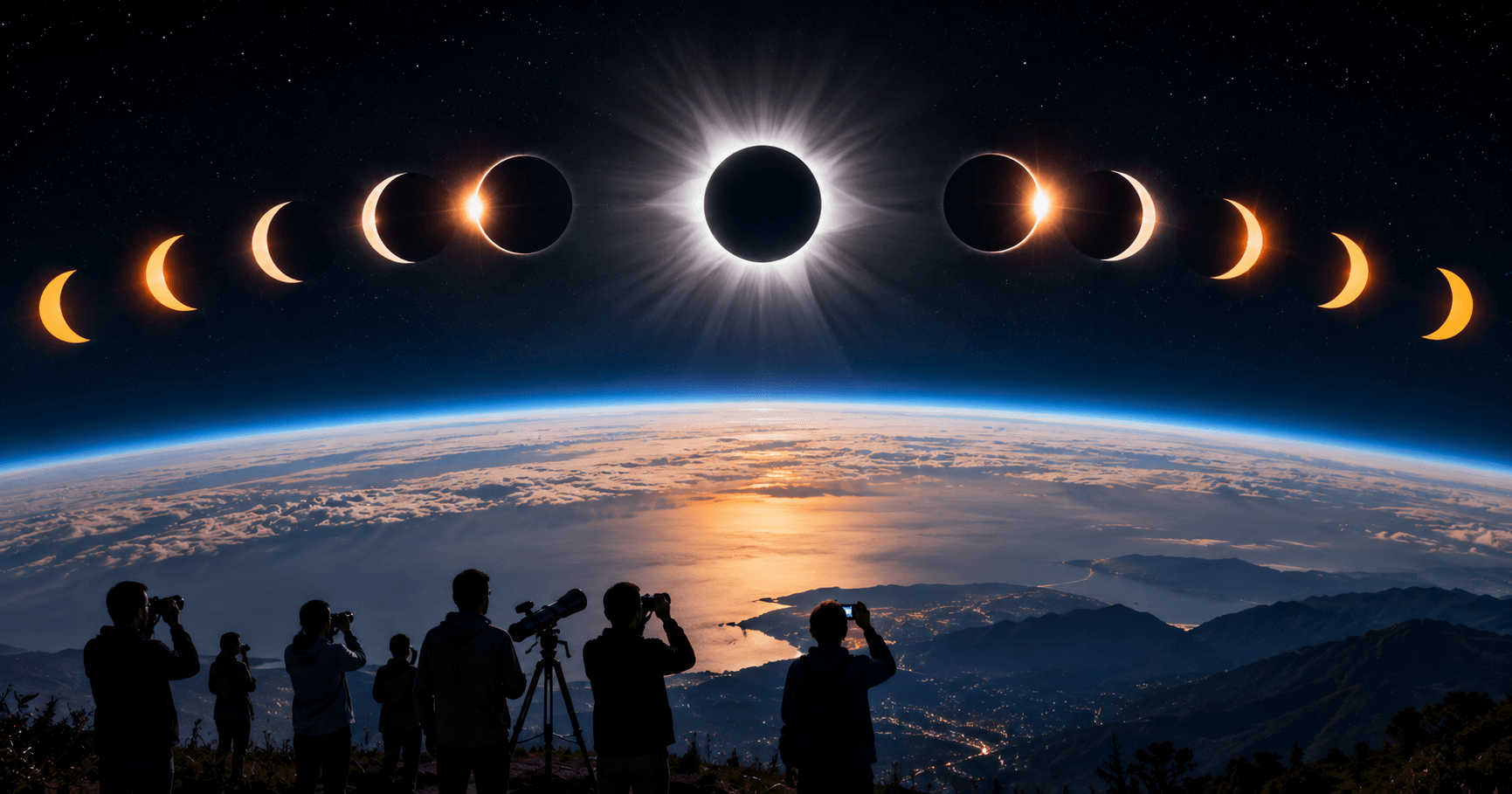
Few astronomical events capture human imagination quite like solar eclipses. For a few extraordinary moments, the Moon moves between Earth and the Sun, transforming daylight into an unusual celestial spectacle.
A solar eclipse is more than a beautiful sky event. It is a remarkable demonstration of orbital mechanics and an important opportunity for scientists to study the Sun, Moon, Earth's atmosphere, and the interaction between them.
For technology and space enthusiasts, eclipses are also fascinating because modern scientists use satellites, telescopes, cameras, computer models, GPS data, and advanced imaging systems to predict, observe, and study these events.
And 2026 is an especially interesting year for eclipse watchers. According to NASA, a total solar eclipse will occur on August 12, 2026, with totality visible across parts of Greenland, Iceland, Spain, Russia, and a small region of Portugal. A much larger area across Europe, Africa, North America, the Atlantic, Arctic, and Pacific regions will experience a partial eclipse.
Let's explore the science behind solar eclipses, their different types, how scientists predict them, how technology is transforming eclipse observation, and how to watch one safely.
What Is a Solar Eclipse?
A solar eclipse occurs when the Moon passes between the Sun and Earth and blocks some or all of the Sun's light from reaching parts of Earth.
The Moon's shadow has different regions, and where an observer is located determines what type of eclipse they see.
Solar eclipses do not happen every month because the Moon's orbit around Earth is tilted relative to Earth's orbit around the Sun. The alignment necessary for an eclipse occurs only during particular periods known as eclipse seasons.
How Does a Solar Eclipse Happen?
Three major bodies are involved:
Sun → Moon → Earth
During a solar eclipse, the Moon moves directly or nearly directly between the Sun and Earth.
The Moon then casts a shadow across Earth's surface.
Depending on the observer's position within that shadow, the Sun may appear:
- Completely covered
- Partially covered
- Surrounded by a bright ring
- Or, in rare circumstances, change between total and annular appearance
The alignment is a remarkable consequence of the geometry of the Sun, Moon, and Earth.
Types of Solar Eclipses
NASA identifies four types of solar eclipses: total, annular, partial, and hybrid.
1. Total Solar Eclipse
A total solar eclipse occurs when the Moon completely covers the Sun's bright visible disk for observers located within the path of totality.
During totality, the sky can become dramatically darker, and the Sun's outer atmosphere—the corona—can become visible.
The corona is normally difficult to observe from Earth because the bright solar surface overwhelms it.
One of the most exciting aspects of a total eclipse is therefore the opportunity to study the corona and its structure.
2. Annular Solar Eclipse
An annular eclipse occurs when the Moon passes between Earth and the Sun but appears slightly smaller than the Sun in the sky.
As a result, the Moon does not completely cover the solar disk.
Instead, a bright ring of sunlight remains visible around the Moon.
This is commonly called the "ring of fire" eclipse.
Because sunlight remains visible throughout an annular eclipse, it is never safe to look directly at the Sun without appropriate solar eye protection.
3. Partial Solar Eclipse
A partial solar eclipse occurs when the Sun, Moon, and Earth are not perfectly aligned from an observer's perspective.
Only part of the Sun is covered, producing a crescent-shaped appearance.
Partial eclipses can be visible across very large regions compared with the narrow path of totality.
However, even if most of the Sun appears covered, the remaining visible portion is still extremely bright and requires proper solar protection.
4. Hybrid Solar Eclipse
A hybrid solar eclipse is a rare type of eclipse that can appear total from some locations and annular from others.
This happens because Earth's curved surface changes the geometry between the observer, Moon, and Sun as the Moon's shadow moves across Earth.
NASA identifies hybrid eclipses as the fourth major type of solar eclipse.
Why Don't Solar Eclipses Happen Every Month?
At first glance, it may seem strange that solar eclipses aren't monthly events.
After all, the Moon orbits Earth approximately once every month.
The key is the tilt of the Moon's orbit.
The Moon's orbital plane is tilted relative to Earth's orbital plane around the Sun. Most months, the Moon passes slightly above or below the Sun from our perspective.
Only when the geometry lines up during an eclipse season can the Moon's shadow fall across Earth.
This orbital geometry is one of the reasons eclipse prediction can be calculated with remarkable precision.
How Scientists Predict Solar Eclipses
Predicting an eclipse requires understanding the movements of:
- Earth
- Moon
- Sun
Modern astronomers use highly precise astronomical models to calculate where the Moon's shadow will travel and when different phases of an eclipse will occur.
Computers can model:
- Eclipse start time
- Maximum eclipse
- End time
- Path of totality
- Duration of totality
- Areas experiencing partial eclipse
- Position of the Moon's shadow
This combination of astronomy and computing allows eclipse maps to be produced years in advance.
The Role of Technology in Studying Solar Eclipses
Solar eclipses have become increasingly important for modern scientific research.
Satellites
Space-based instruments can observe the Sun without Earth's atmosphere interfering with observations.
Satellites help scientists study solar activity, the corona, and changes in solar radiation.
High-Speed Cameras
Modern cameras can capture extremely detailed images of the Sun and Moon during different eclipse phases.
Telescopes
Specialized solar telescopes allow researchers to study features of the Sun that are difficult to observe under normal conditions.
Computer Simulations
Scientists can model eclipse geometry and predict the Moon's shadow across Earth's surface.
Citizen Science
During major eclipses, members of the public can contribute observations, photographs, environmental measurements, and other data to scientific projects.
Technology therefore allows an eclipse to become more than a visual event—it can become a large-scale scientific experiment.
Why Scientists Study Solar Eclipses
Solar eclipses provide unusual opportunities to study the Sun.
Studying the Solar Corona
During totality, the Moon blocks the bright solar disk, allowing the corona to become visible.
Scientists can examine structures and activity in this outer atmosphere.
Understanding Solar Activity
The Sun is an active star. Changes in solar activity can influence space weather and the near-Earth environment.
Understanding the Sun is therefore important not only for astronomy but also for modern technology.
Studying Earth's Atmosphere
Solar eclipses can temporarily change the amount of sunlight reaching particular regions.
Researchers can use these changes to investigate atmospheric responses.
Solar Eclipses and Weather
Weather can have a major effect on the eclipse-viewing experience.
Clouds can obscure the Sun even when an eclipse is taking place.
This is why eclipse watchers often examine:
- Cloud forecasts
- Rain probability
- Visibility
- Local weather conditions
- Historical climate patterns
For major eclipses, weather forecasting becomes particularly important because the path of totality may cross thousands of kilometres.
This creates an interesting connection between astronomy and meteorology: astronomers can predict exactly where the eclipse will occur, but observers still need suitable weather conditions to see it.
Solar Eclipse 2026: What to Know
One of the most important upcoming astronomical events is the total solar eclipse on August 12, 2026.
According to NASA, totality will be visible in:
- Greenland
- Iceland
- Spain
- Russia
- A small area of Portugal
A partial solar eclipse will be visible across much broader areas, including parts of:
- Europe
- Africa
- North America
- The Atlantic Ocean
- Arctic regions
- Pacific regions
The exact experience will depend on an observer's location.
Anyone planning to watch should check an authoritative eclipse map and local weather forecast close to the event.
How to Watch a Solar Eclipse Safely
Solar eclipse safety is extremely important.
Except during the brief totality phase of a total solar eclipse, looking directly at the Sun without appropriate protection can seriously injure the eyes.
NASA specifically warns that regular sunglasses are not safe for viewing the Sun.
Use Proper Eclipse Glasses
Use safe solar viewing glasses or a handheld solar viewer designed specifically for viewing the Sun.
Solar viewers should meet the appropriate ISO 12312-2 standard.
Never Look Through Unfiltered Optics
Do not look at the Sun through:
- Ordinary cameras
- Binoculars
- Telescopes
- Camera telephoto lenses
unless the optical equipment has a properly designed solar filter installed at the front.
Concentrated sunlight can cause severe eye injury.
Try Indirect Viewing
A simple pinhole projector can project an image of the Sun onto a surface without requiring you to look directly at it.
This is one of the simplest ways to observe the changing shape of the eclipsed Sun safely.
Solar Eclipse Photography
Eclipse photography has become extremely popular.
However, photographing the Sun requires the same precautions as visual observation.
A camera should not be pointed at the Sun through an ordinary lens without an appropriate solar filter.
For telescopes and binoculars, solar filters must be specifically designed for the equipment and attached correctly.
During totality, the rules change briefly because the Moon completely blocks the bright solar disk. Once even a small portion of the bright Sun becomes visible again, proper eye protection is required immediately.
Solar Eclipses in History and Culture
Solar eclipses have fascinated humanity for thousands of years.
Before modern astronomy, eclipses were sometimes interpreted through religious, cultural, or supernatural explanations.
As scientific understanding developed, astronomers learned that eclipses were predictable consequences of celestial mechanics.
Today, the same phenomenon that once inspired uncertainty is used to demonstrate:
- Orbital mechanics
- Solar physics
- Mathematical prediction
- Space science
- Earth's atmospheric response
This transition from mystery to measurable science is one of the most fascinating aspects of eclipse history.
Solar Eclipses and Space Weather
Solar eclipses also connect naturally with the growing field of space weather.
The Sun produces solar flares, coronal mass ejections, and streams of charged particles. These phenomena can affect satellites, radio communications, navigation systems, and other technological infrastructure.
Studying the Sun's corona during eclipses can contribute to broader scientific understanding of solar activity.
For a technology-driven world increasingly dependent on satellites and communication networks, understanding our star is becoming increasingly important.
What Is the Difference Between a Solar and Lunar Eclipse?
The simplest distinction is:
Solar eclipse: The Moon blocks the Sun from Earth's perspective.
Lunar eclipse: Earth comes between the Sun and Moon, causing Earth's shadow to fall on the Moon.
Solar eclipses occur around the new Moon, while lunar eclipses occur around the full Moon when the required alignment occurs.
Frequently Asked Questions About Solar Eclipses
How often do solar eclipses happen?
Solar eclipses occur somewhere on Earth several times a year, but any particular location may go much longer without experiencing one.
How long does a total solar eclipse last?
Totality can last from only seconds to several minutes. NASA notes that total solar eclipses can last up to about 7.5 minutes, depending on the specific eclipse and location.
Can I look at a partial solar eclipse with sunglasses?
No. Ordinary sunglasses are not sufficient protection for directly viewing the Sun during a partial eclipse. Proper solar viewing equipment should be used.
What is the ring of fire eclipse?
A "ring of fire" is an annular solar eclipse, during which the Moon appears smaller than the Sun and leaves a bright ring of sunlight visible around it.
When is the next major total solar eclipse?
NASA lists August 12, 2026 as the date of the next total solar eclipse in its current future-eclipse schedule.
The Future of Solar Eclipse Research
The future of eclipse science will increasingly combine astronomy with advanced technology.
Artificial intelligence, high-resolution imaging, satellite observations, computer simulations, automated telescopes, and citizen-science networks could make future eclipse observations more detailed than ever.
As space agencies deploy increasingly capable solar-observing spacecraft, scientists will continue improving their understanding of the Sun and its influence on Earth.
Solar eclipses will therefore remain both spectacular public events and valuable scientific opportunities.
The growing importance of space weather also means that understanding solar activity is becoming increasingly relevant to our technology-dependent society.
Sources: Verified & Authoritative
NASA Science – Solar Eclipse Types
NASA explains total, annular, partial, and hybrid solar eclipses and the orbital geometry behind them.
NASA Science – Eclipse Viewing Safety
Official guidance covering eclipse glasses, solar viewers, optical equipment, and safe observation techniques.
NASA Science – Future Eclipses
Official schedule and visibility information for upcoming solar and lunar eclipses, including the August 12, 2026 total solar eclipse.
NASA Science – August 12, 2026 Total Solar Eclipse
Official information about the 2026 total solar eclipse and safe viewing.
NASA Science – Eclipse FAQ
Additional authoritative information about eclipse frequency, duration, and types.