

Automotive Wiring Harness Design
by UptoSkills Team, Debasish Mohapatra
Missions
15
Quests
104
Games
25
XP
500
Coins
40
Certificate optional — ₹499, or ₹199 on Pro
Key Benefits
Earn XP & Level Up
Gain 500 XP to unlock badges and achievements
Collect Coins
Earn 40 coins to redeem rewards
Professional Certificate
QR-verified and recruiter-checkable — ₹499, or ₹199 on Pro
Unlock Achievements
Complete challenges and earn exclusive badges
Certificate Preview
Finish the league and this is what you walk away with.
We'll post you a printed copy — free.
Tick one box at checkout and it ships anywhere in India in 14–21 days. Almost nobody here does this free.

Learn and Earn Platform
Certificate of Completion
This is to certify that
Your Name
has successfully completed the comprehensive
"Automotive Wiring Harness Design"
League Program
This certificate acknowledges the successful completion of all required coursework and assessments. The recipient has demonstrated proficiency in the subject matter.
September 4, 2026

VERIFIED & AUTHENTIC
Official Seal
UTS-LEAGUE-PREVIEW
Scan to verify
✨ QR-verified · high-quality PDF
Every lesson, quest and game here is free. Forever.
Standard
₹499
one-time
With Pro
₹199
per certificate
So why isn't the certificate free? One anybody can print is worth nothing to a recruiter. The fee covers evaluation, QR-backed verification and lifetime hosting — that's what makes it checkable.
Hall of Fame
About This League
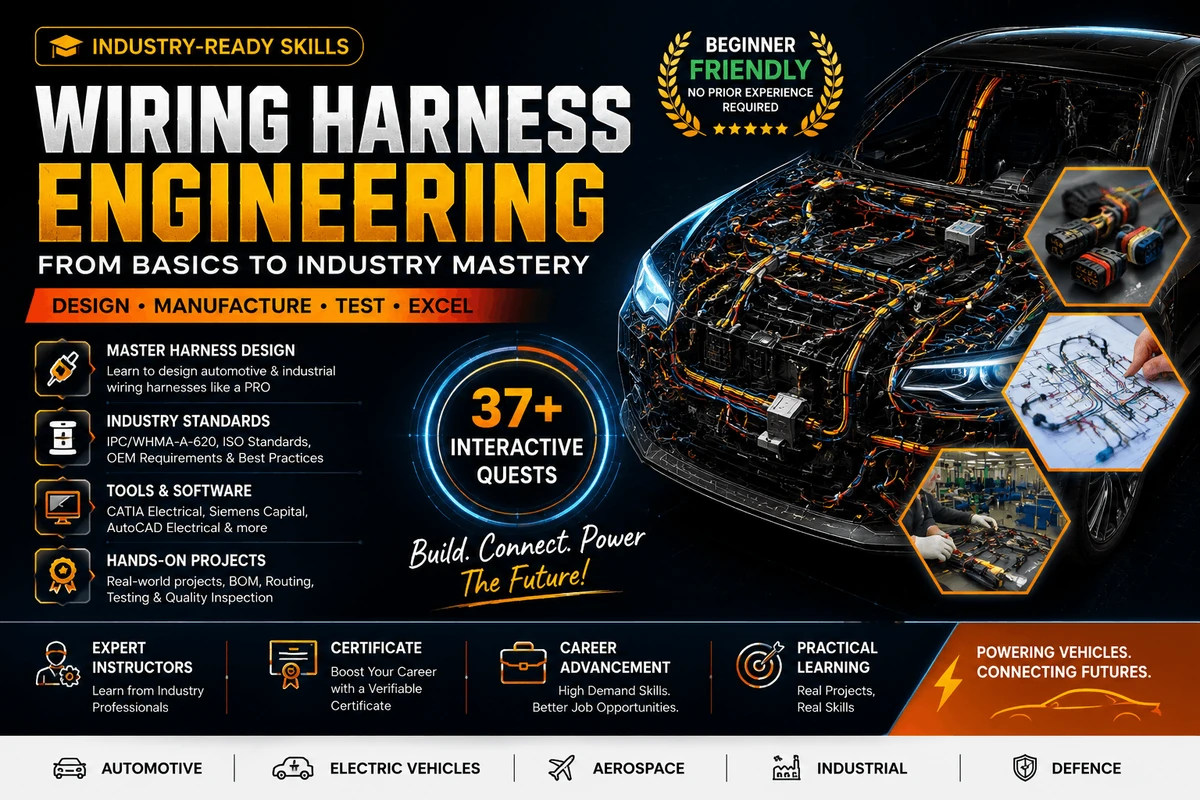
This league equips aspiring engineers with foundational knowledge in automotive wiring harness design. Students will learn to interpret diagrams, select components, and understand assembly principles. The curriculum covers essential tools and quality control for effective harness creation.
What you will learn
Upon completing this league, you will be able to:
- Interpret automotive wiring diagrams and identify key components and connections accurately.
- Select appropriate wires, connectors, and terminals based on application requirements and environmental factors.
- Utilize essential hand tools for wire stripping, crimping, and soldering to create secure terminations.
- Apply basic harness design principles for efficient routing, strain relief, and protection.
- Perform basic electrical testing for continuity, shorts, and open circuits in wire harnesses.
- Understand industry readiness by preparing for interviews and developing a project portfolio for placement opportunities.
What this league covers
| Module | What it covers |
|---|---|
| Introduction to Wiring Harness Engineering | Learn about the essential role of wiring harnesses and their key components like wires, cables, and connectors. |
| Understanding Wire Basics | Explore wire gauge (AWG), conductor materials, insulation types, color coding, and voltage drop considerations. |
| Connectors and Terminals Unveiled | Understand various connector types (pin and socket, blade and receptacle) and terminal types (ring, spade, bullet), including sealing mechanisms. |
| Wire Harness Assembly Tools | Familiarize yourself with wire stripping, crimping tools, soldering irons, and tools for wire routing and securing. |
| Basic Harness Design Principles | Gather design requirements, understand circuit diagrams, and strategize wire routing, connector placement, and strain relief. |
| Wire Termination Techniques | Master proper crimping, soldering best practices, insulating connections with heat shrink and tape, and wire splicing. |
| Harness Protection and Management | Learn about sleeving, wire loom, convoluted tubing, and securing methods like zip ties and clamps for harness protection. |
| Introduction to Wiring Diagrams | Decipher symbols, lines, connections, wire numbering, and component identification in wiring diagrams. |
| Harness Assembly Workflow | Follow a step-by-step process for workspace preparation, wire cutting, termination, assembly, routing, and final inspection. |
| Quality Control in Harness Assembly | Implement visual inspection techniques and electrical testing for continuity, shorts, and open circuits. |
| Introduction to Wire Harness Design Software | Explore common harness design software, project creation, schematic import, component placement, and report generation. |
| Environmental Considerations | Understand the impact of temperature, moisture, vibration, chemicals, and UV exposure on material selection. |
| Advanced Connector and Terminal Selection | Examine high-density, sealed, high-temperature, and vibration-resistant connectors, and interpret component datasheets. |
| Harness Manufacturing Processes | Gain insights into automated wire processing, mass termination, overmolding, and lean manufacturing principles. |
| Industry Readiness: Next Steps | Learn about common industries, standards, resume building, interview preparation, and portfolio development for placement. |
Students will be equipped to develop a project portfolio for placement opportunities.
A look inside
Prerequisites
- Comfortable reading a wiring or circuit diagram.
- Understand voltage, current and resistance.
Learning Objectives
- Understand the fundamentals of Wiring Harness Engineering and its applications in the automotive industry.
- Identify and select appropriate wiring harness components, including wires, connectors, terminals, and protective materials.
- Interpret automotive wiring diagrams, electrical schematics, and harness layouts with confidence.
- Apply industry-standard wiring harness design, routing, packaging, and manufacturing principles.
- Understand quality standards, testing methods, and safety practices used by leading automotive manufacturers.
- Develop practical skills through real-world projects and industry-based case studies.
- Build the technical knowledge and problem-solving skills required for entry-level Wiring Harness Engineering roles.
- Prepare for careers and technical interviews in Automotive Wiring Harness Engineering with industry-relevant knowledge.
Earn XP • Collect Coins • Unlock Achievements