

Go for DevOps and Microservices
by UptoSkills Team
Missions
11
Quests
87
Games
26
XP
750
Coins
30
Certificate optional — ₹499, or ₹199 on Pro
Key Benefits
Earn XP & Level Up
Gain 750 XP to unlock badges and achievements
Collect Coins
Earn 30 coins to redeem rewards
Professional Certificate
QR-verified and recruiter-checkable — ₹499, or ₹199 on Pro
Unlock Achievements
Complete challenges and earn exclusive badges
Certificate Preview
Finish the league and this is what you walk away with.
We'll post you a printed copy — free.
Tick one box at checkout and it ships anywhere in India in 14–21 days. Almost nobody here does this free.

Learn and Earn Platform
Certificate of Completion
This is to certify that
Your Name
has successfully completed the comprehensive
"Go for DevOps and Microservices"
League Program
This certificate acknowledges the successful completion of all required coursework and assessments. The recipient has demonstrated proficiency in the subject matter.
September 4, 2026

VERIFIED & AUTHENTIC
Official Seal
UTS-LEAGUE-PREVIEW
Scan to verify
✨ QR-verified · high-quality PDF
Every lesson, quest and game here is free. Forever.
Standard
₹499
one-time
With Pro
₹199
per certificate
So why isn't the certificate free? One anybody can print is worth nothing to a recruiter. The fee covers evaluation, QR-backed verification and lifetime hosting — that's what makes it checkable.
Hall of Fame
About This League
DevOps and Microservices are fundamental to modern software development, enabling faster delivery and scalable applications. This comprehensive league equips students with the practical skills needed to build, deploy, and manage complex systems efficiently. It focuses on industry-standard tools and practices for career advancement.
What you will learn
Upon completing this league, you will be able to:
- Implement version control workflows and manage code repositories using Git, including branching, merging, and resolving conflicts.
- Build and deploy containerized applications using Docker, understanding images, containers, Dockerfiles, and Docker Compose.
- Establish automated CI/CD pipelines with Jenkins for building, testing, and deploying applications.
- Provision and manage cloud infrastructure using Terraform, defining resources, modules, and state management.
- Orchestrate containerized applications with Kubernetes, managing pods, deployments, services, and scaling.
- Set up and utilize monitoring with Prometheus and Grafana, and implement logging solutions with the ELK stack for system observability.
What this league covers
| Module | What it covers |
|---|---|
| Introduction to DevOps | Understanding core DevOps principles, its lifecycle, key practices, and the importance of collaboration and automation. |
| Introduction to Microservices | Exploring microservices architecture, its benefits and challenges, communication patterns, and decomposing monolithic applications. |
| Version Control with Git | Mastering Git installation, repository management, branching, merging, working with remotes, and resolving conflicts efficiently. |
| Introduction to Docker | Learning containerization with Docker, including image and container management, Dockerfiles, networking, and Docker Compose. |
| Continuous Integration with Jenkins | Implementing CI/CD with Jenkins, job creation, Git integration, automated testing, and build automation. |
| Infrastructure as Code with Terraform | Defining and managing infrastructure using Terraform, including providers, resources, modules, and state management. |
| Container Orchestration with Kubernetes | Orchestrating containers with Kubernetes, understanding its architecture, pods, deployments, services, and scaling applications. |
| Monitoring with Prometheus and Grafana | Setting up monitoring systems with Prometheus for metric collection and Grafana for data visualization and alerting. |
| Logging with ELK Stack | Implementing logging solutions with Elasticsearch, Logstash, and Kibana for log analysis and visualization. |
| Introduction to Serverless Computing | Understanding serverless concepts, AWS Lambda deployment, the Serverless Framework, and API Gateway integration. |
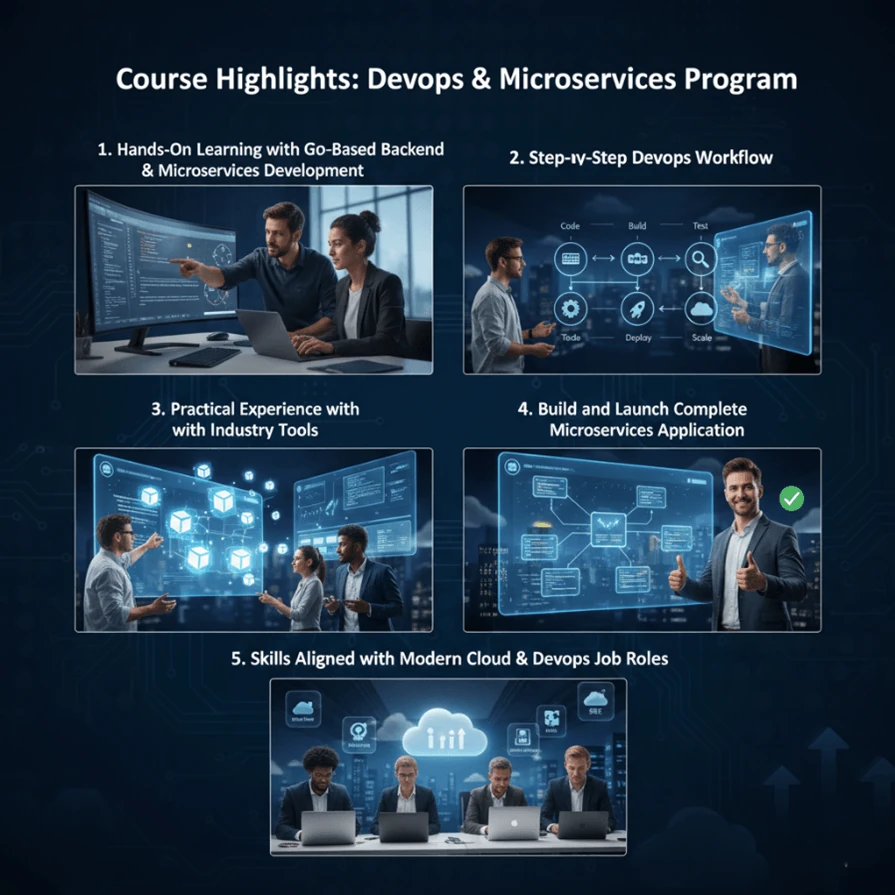
| Putting it All Together: DevOps Pipeline for Microservices | Designing and configuring a complete DevOps pipeline for microservices, integrating Git, Jenkins, Docker, Kubernetes, and monitoring. |
Students will be prepared to build and manage modern cloud-native applications.
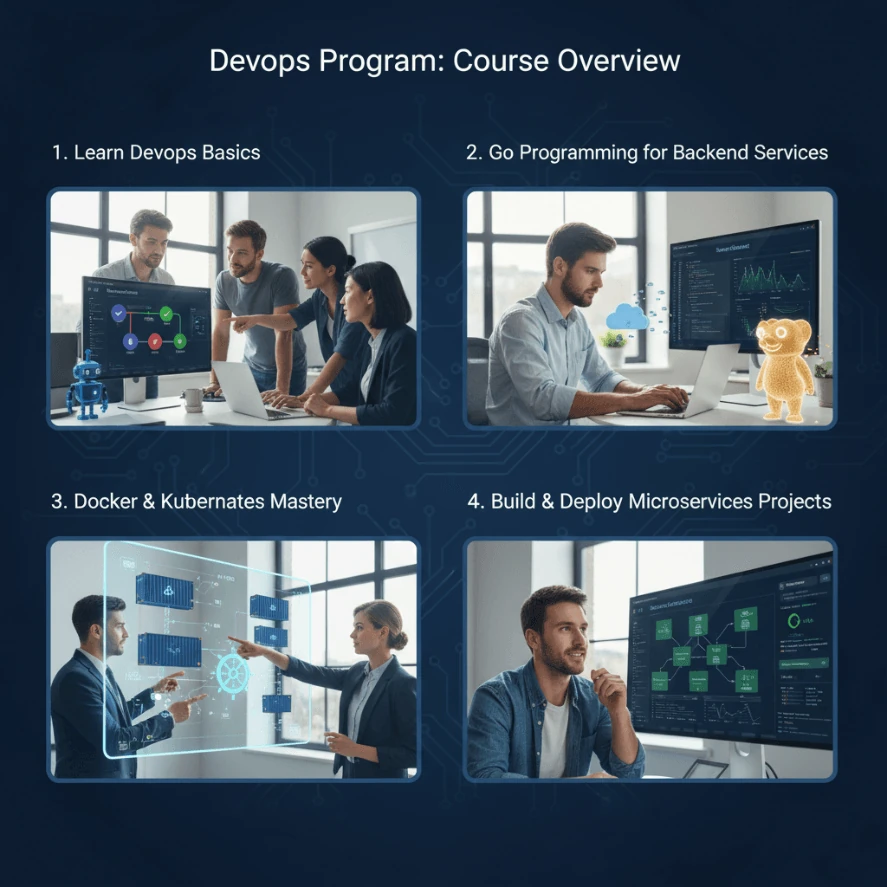
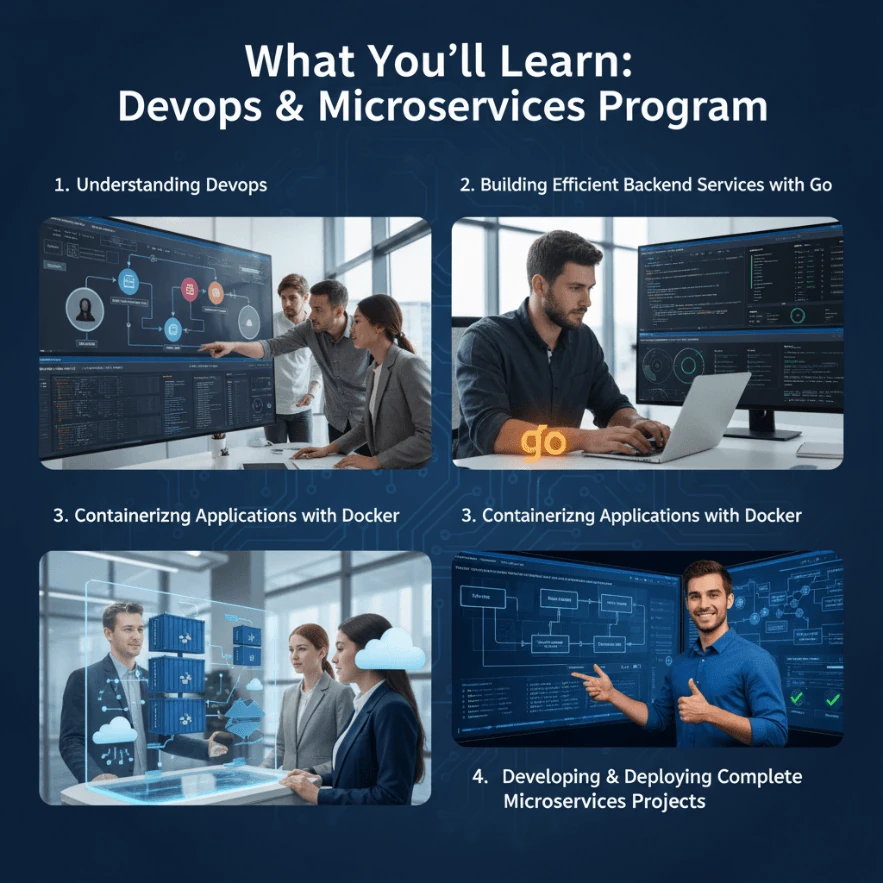
A look inside
Prerequisites
- Comfortable writing and running programs in any language.
- Confident on the command line — navigating directories, running commands, editing files.
- Understand IP addresses, ports and DNS well enough to debug a failed connection.
- Have deployed or run an application somewhere, even if only on your own machine.
Learning Objectives
- Understand the principles of DevOps and apply them in real development workflows.
- Build backend services using Go with clean, maintainable code.
- Containerize applications using Docker for consistent environment deployment.
- Deploy and manage microservices on Kubernetes with proper scaling and monitoring.
- Implement a complete CI/CD pipeline to automate building, testing, and deployment.
- Design and deploy a functional microservices project using Go and DevOps tools.
Earn XP • Collect Coins • Unlock Achievements