

C++ Programming
by UptoSkills Team
Missions
13
Quests
82
Games
26
XP
650
Coins
35
Certificate optional — ₹499, or ₹199 on Pro
Key Benefits
Earn XP & Level Up
Gain 650 XP to unlock badges and achievements
Collect Coins
Earn 35 coins to redeem rewards
Professional Certificate
QR-verified and recruiter-checkable — ₹499, or ₹199 on Pro
Unlock Achievements
Complete challenges and earn exclusive badges
Certificate Preview
Finish the league and this is what you walk away with.
We'll post you a printed copy — free.
Tick one box at checkout and it ships anywhere in India in 14–21 days. Almost nobody here does this free.

Learn and Earn Platform
Certificate of Completion
This is to certify that
Your Name
has successfully completed the comprehensive
"C++ Programming"
League Program
This certificate acknowledges the successful completion of all required coursework and assessments. The recipient has demonstrated proficiency in the subject matter.
September 4, 2026

VERIFIED & AUTHENTIC
Official Seal
UTS-LEAGUE-PREVIEW
Scan to verify
✨ QR-verified · high-quality PDF
Every lesson, quest and game here is free. Forever.
Standard
₹499
one-time
With Pro
₹199
per certificate
So why isn't the certificate free? One anybody can print is worth nothing to a recruiter. The fee covers evaluation, QR-backed verification and lifetime hosting — that's what makes it checkable.
Hall of Fame
About This League
C++ is a powerful, versatile programming language widely used for system programming, game development, and high performance applications. This league provides a comprehensive introduction to C++ fundamentals, equipping students with the essential knowledge and practical skills needed for a solid programming foundation.
What you will learn
Upon completing this league, you will be able to:
- Write and execute basic C++ programs, understanding syntax, comments, and error debugging.
- Declare and manipulate variables of various data types, including integers, floats, characters, and booleans.
- Apply arithmetic, comparison, logical, and bitwise operators to perform complex calculations and comparisons.
- Implement control flow structures like if statements and loops for conditional execution and repetitive tasks.
- Design and utilize functions for modularity, code reusability, and recursion.
- Grasp the core concepts of Object-Oriented Programming, including classes, objects, constructors, and inheritance.
What this league covers
| Module | What it covers |
|---|---|
| Introduction to C++ | Understand C++'s role, set up your development environment, and write your first program, covering basic syntax and error debugging. |
| Variables and Data Types | Learn to declare and use variables for integer, floating-point, character, and boolean data, along with understanding scope and type conversion. |
| Operators in C++ | Explore arithmetic, assignment, comparison, logical, bitwise, and increment/decrement operators for effective data manipulation. |
| Input and Output | Master using cout for output and cin for input, including output formatting and input validation with strings. |
| Control Flow: If Statements | Implement conditional logic using basic, if else, nested if, and else if statements, and the ternary operator. |
| Control Flow: Loops | Utilize for, while, and do-while loops for iteration, including break, continue, nested loops, and looping through arrays. |
| Arrays | Understand declaring, initializing, and accessing elements in single and multidimensional arrays, with emphasis on bounds checking. |
| Functions | Define and use functions, pass arguments, return values, and explore function overloading, default arguments, and recursion. |
| Pointers | Learn about declaring, initializing, and dereferencing pointers, dynamic memory allocation, pointer arithmetic, and null pointers. |
| Strings | Work with the C++ string class, covering manipulation, concatenation, comparison, searching, and extracting substrings. |
| Structures | Define and use structures to group related data, access members, and work with structures in functions and arrays. |
| Object-Oriented Programming: Classes and Objects | Introduce OOP concepts, define classes and objects, manage members, and utilize constructors and destructors. |
| Object-Oriented Programming: Inheritance | Explore inheritance, base and derived classes, different inheritance types, protected members, and virtual functions. |
Equipped with C++ fundamentals, you can now explore Java Programming.
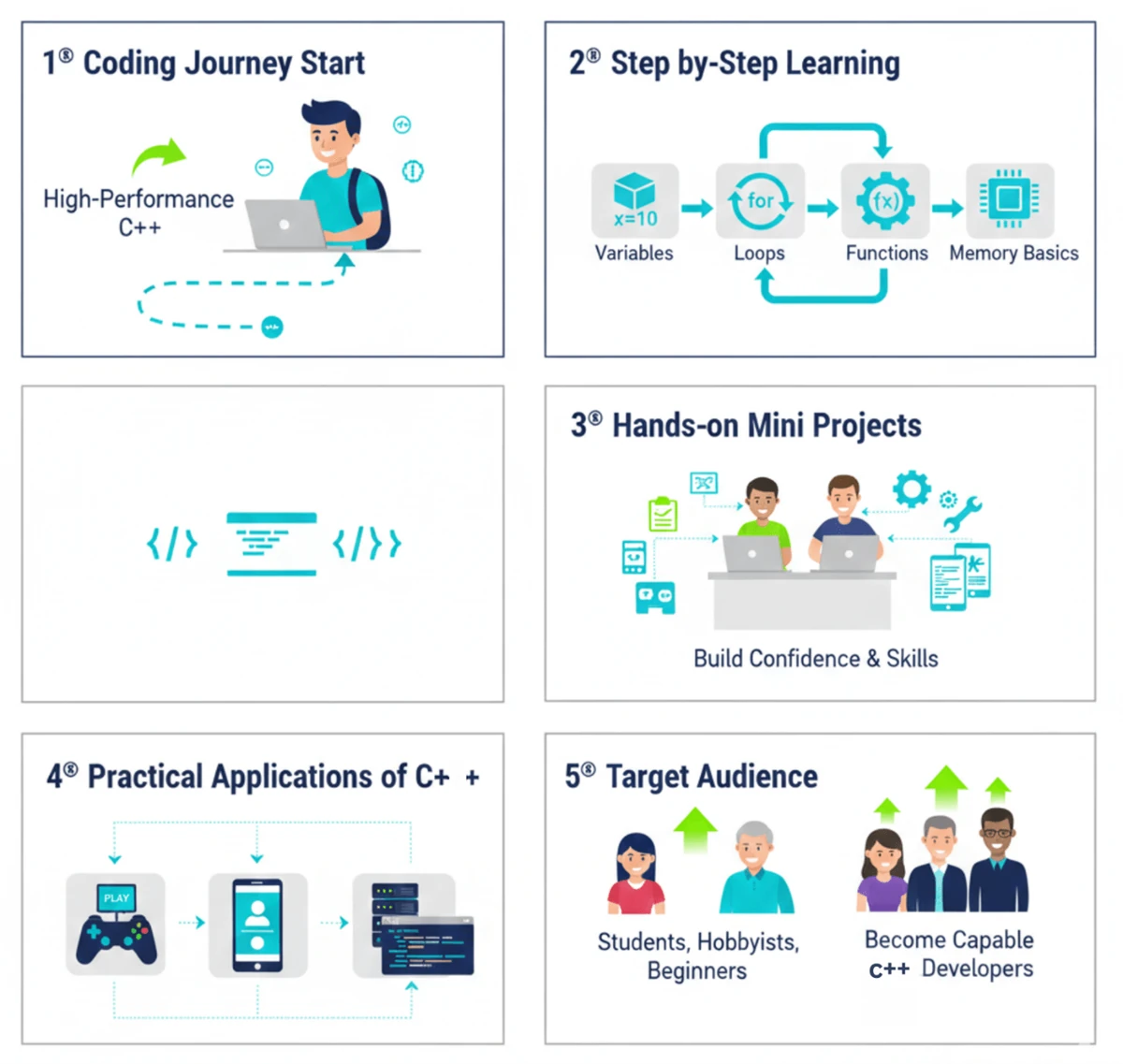
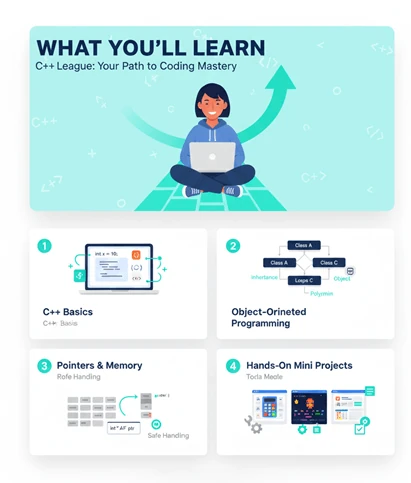
A look inside

Prerequisites
- Understand variables, loops, conditionals and functions in some language.
- Understand how memory and pointers work, at least in outline.
Learning Objectives
- Understand the fundamental data types (int, float, char, bool) and operators in C++ to effectively store and manipulate data.
- Create simple C++ programs using input/output streams (cin and cout) to interact with the user.
- Implement conditional statements (if, else if, else) to control program flow based on specified conditions.
- Utilize looping structures (for, while, do-while) to automate repetitive tasks and iterate through data.
- Analyze a given problem statement and design a basic algorithm using variables, data types and control structures (loops and conditional statements) to solve it in C++.
- Implement functions with parameters and return values to modularize code and improve readability.
Earn XP • Collect Coins • Unlock Achievements