

Data Science
by UptoSkills Team
Missions
13
Quests
82
Games
34
XP
700
Coins
35
Certificate optional — ₹499, or ₹199 on Pro
Key Benefits
Earn XP & Level Up
Gain 700 XP to unlock badges and achievements
Collect Coins
Earn 35 coins to redeem rewards
Professional Certificate
QR-verified and recruiter-checkable — ₹499, or ₹199 on Pro
Unlock Achievements
Complete challenges and earn exclusive badges
Certificate Preview
Finish the league and this is what you walk away with.
We'll post you a printed copy — free.
Tick one box at checkout and it ships anywhere in India in 14–21 days. Almost nobody here does this free.

Learn and Earn Platform
Certificate of Completion
This is to certify that
Your Name
has successfully completed the comprehensive
"Data Science"
League Program
This certificate acknowledges the successful completion of all required coursework and assessments. The recipient has demonstrated proficiency in the subject matter.
September 4, 2026

VERIFIED & AUTHENTIC
Official Seal
UTS-LEAGUE-PREVIEW
Scan to verify
✨ QR-verified · high-quality PDF
Every lesson, quest and game here is free. Forever.
Standard
₹499
one-time
With Pro
₹199
per certificate
So why isn't the certificate free? One anybody can print is worth nothing to a recruiter. The fee covers evaluation, QR-backed verification and lifetime hosting — that's what makes it checkable.
Hall of Fame
About This League
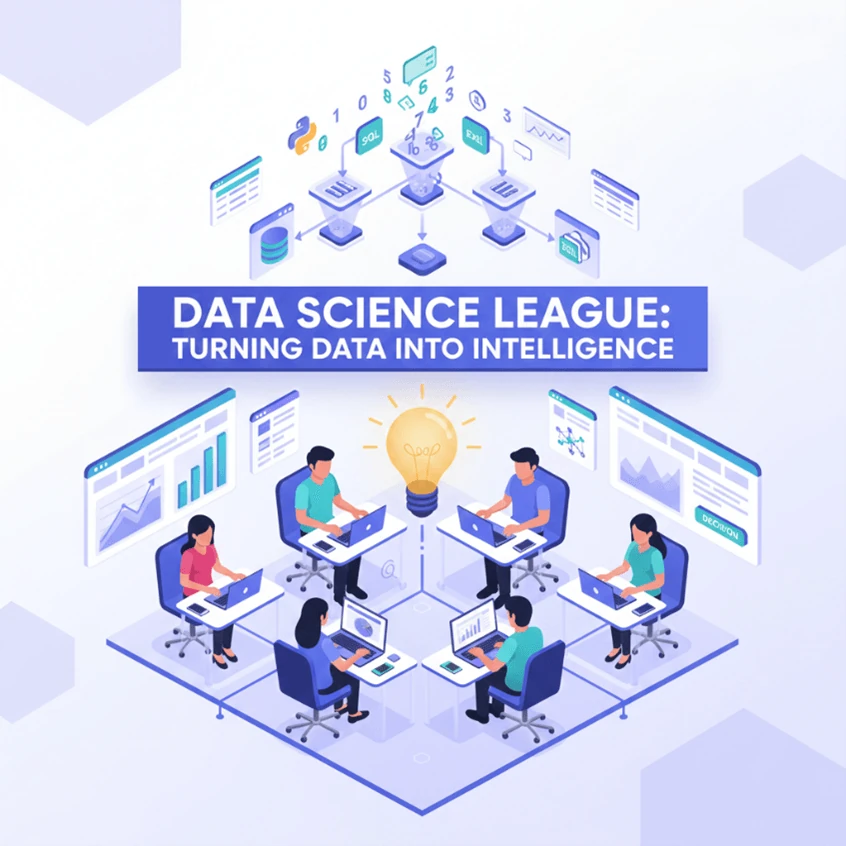
Data Science involves extracting knowledge and insights from data. This beginner-level league provides a comprehensive foundation in the essential tools and techniques used in the field. It is designed for students aiming for placements and internships in data-related roles.
What you will learn
Upon completion, you will be able to:
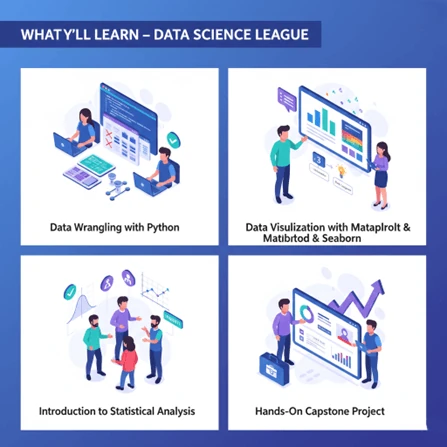
- Analyze and clean real-world datasets using Python and Pandas libraries.
- Create informative data visualizations with Matplotlib to communicate insights.
- Understand core statistical concepts and apply hypothesis testing.
- Implement and evaluate fundamental machine learning algorithms like regression and classification.
- Perform essential data preprocessing and model validation techniques for robust results.
- Apply your skills to a comprehensive data analysis and prediction project.
What this league covers
| Module | What it covers |
|---|---|
| Introduction to Data Science | Understand what data science is, its real-world applications, the data science process, essential skills, and setting up your development environment. |
| Python for Data Science: The Basics | Learn Python syntax, variables, data types, operators, control flow with if-else and loops, and defining functions. |
| Data Manipulation with Pandas | Master Pandas DataFrames: creation, loading, selection, filtering, cleaning missing values, transformation, grouping, and merging. |
| Data Visualization with Matplotlib | Create and customize basic and advanced plots like line plots, scatter plots, histograms, bar charts, and subplots. |
| Statistical Foundations | Grasp descriptive statistics, measures of variability, probability basics, common distributions, hypothesis testing, correlation, and regression. |
| Introduction to Machine Learning | Explore supervised and unsupervised learning, model evaluation metrics, the ML workflow, and the bias-variance tradeoff. |
| Linear Regression | Understand and implement simple and multiple linear regression, evaluate models, and learn about regularization techniques. |
| Logistic Regression | Build and interpret logistic regression models for classification, understand regularization, and explore multiclass applications. |
| Decision Trees | Learn to build, prune, and evaluate decision trees using splitting criteria like Gini and entropy, and understand their pros and cons. |
| Clustering with K-Means | Understand clustering, implement K-Means, choose the optimal number of clusters, and evaluate its assumptions and applications. |
| Data Preprocessing Techniques | Master data cleaning, scaling, normalization, encoding categorical variables, feature selection, PCA, and data splitting. |
| Model Evaluation and Validation | Deep dive into cross-validation, regression and classification metrics, confusion matrices, ROC curves, AUC, and hyperparameter tuning. |
| Project: Data Analysis and Prediction | Execute a full project from dataset overview and EDA to model building, evaluation, and reporting. |
You will be equipped to perform data analysis and build predictive models.
A look inside
Prerequisites
- Comfortable writing Python, including lists, dictionaries and functions.
- Comfortable with mean, median, distributions and basic probability.
- Comfortable with algebra, percentages and reading a graph.
Learning Objectives
- Understand the fundamental concepts of data science, including data types, data sources, and the data science pipeline.
- Create basic data visualizations using Python libraries like Matplotlib and Seaborn to explore and communicate data insights.
- Implement simple data cleaning techniques using Python and Pandas to handle missing values and inconsistencies in datasets.
- Analyze datasets using descriptive statistics to identify patterns, trends, and outliers.
- Apply introductory machine learning algorithms, such as linear regression, to predict outcomes based on input data.
- Understand the ethical considerations involved in data collection, analysis, and application.
Earn XP • Collect Coins • Unlock Achievements